|
FAMSI © 2003: J. Gregory Smith, Ph.D. |
|
Kulubá Archaeological Project 2001 Field Season
Research Year: 2001 Table of Contents
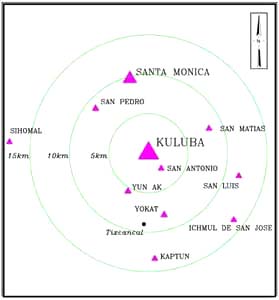
Summary Fieldwork during the summer of 2001 in the Kulubá region of Yucatán has provided valuable data about this Maya polity. The central research question involved how Kulubá was related to Chichén Itzá. Previous research has demonstrated that the site of Kulubá has examples of Chichén-style architecture as well as similarities in portable artifacts such as ceramics and obsidian. To approach the question from a different perspective, focus was shifted away from Kulubá itself and to lower-order centers within its political orbit. In all, the civic centers of 5 sites within 15 km of Kulubá were mapped. None of these sites have any stylistic affiliations with Chichén Itzá. The evidence suggests that Chichén’s influence was limited to just the polity capital of Kulubá and not down its settlement hierarchy. It appears that political control on the part of Chichén Itzá at Kulubá was indirect and did not involve territorial consolidation. El trabajo de campo durante el verano del 2001 en la región Kulubá de Yucatán ha proporcionado información de gran valor sobre este sistema de gobierno maya. La pregunta central de la investigación tenía que ver con la manera en que Kulubá estuvo relacionada con Chichén Itzá. Investigaciones anteriores han demostrado que el sitio de Kulubá tiene ejemplos de arquitectura de estilo Chichén, así como similitudes en artefactos transportables como las cerámicas y la obsidiana. Para abordar estas cuestiones desde una perspectiva diferente, cambiamos el enfoque sobre la propia Kulubá para concentrarnos en otros sitios de menor rango dentro de su órbita política. En total, fueron relevados y mapeados los centros cívicos de 5 sitios en 15km a la redonda de Kulubá. Ninguno de todos estos sitios tiene afiliaciones estilísticas con Chichén Itzá. La evidencia sugiere que la influencia de Chichén Itzá estuvo limitada solamente a la capital política de Kulubá, y no a la jerarquía inferior de los asentamientos. Aparentemente, el control político sobre Kulubá por parte de Chichén Itzá fue indirecto, y no implicó una consolidación territorial. Click to download the report in PDF format: Kulubá Archaeological Project 2001 Field Season (11.8 MB) The PDF files require Adobe Acrobat Reader.
Submitted 10/28/2002 by: |
||
| Return to top of page | ||
|
Text links to all pages at this site are available at the FAMSI INDEX |
||