|
FAMSI © 2007: Bryan R. Just |
|
Ninth-Century Stelae of Machaquilá and Seibal
Research Year: 2002 Table of Contents
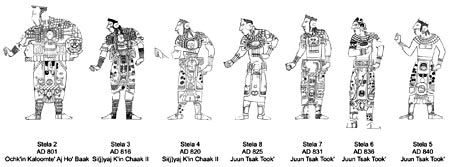
Abstract This report explores how ancient Maya artists and ruler-patrons adapted Late Classic Stelae iconographic and formal conventions to the dramatic socio-political changes of the ninth century A.D. at Machaquilá and Seibal. Sculptors at each site produced a series of ruler-portrait stelae proclaiming the political power of local kings following the violent demise of the region's dominant Mutal polity of the Petexbatún lakes region. Initially, sculptors at each site portrayed local ruler-patrons as the regional successors of Mutal kings by adopting the visual conventions of that polity. Subsequently, however, stelae at Machaquilá and Seibal diverged significantly. Machaquilá's conservative stelae presented increasingly streamlined, 'legible' compositions to stress socio-political stability and to encompass a wider potential audience, possibly including non-elite Maya and/or foreign audiences. In contrast, Seibal's artists heterogeneously employed old, new, and foreign visual devices. Seibal's late stelae implement traditional Maya visual conventions primarily to contrast with non-local modes of expression, reflecting a decline in the local visual system's social power. The eclecticism of Seibal's late stelae contradicts past proposals of foreign invasion and takeover. Instead, Seibal's local authorities chose to present themselves as 'cosmopolitan' in a context of increasingly international interaction. Este ensayo es un resumen de la tesis doctoral del autor, que explora cómo los artistas mayas y sus reyes patrocinadores adaptaron las convenciones iconográficas y formales de la escultura del Clásico tardío maya a los cambios políticos y sociales tan profundos del siglo IX en los sitios de Ceibal y de Machaquilá. Los escultores de cada sitio fabricaron una serie de estelas con los rostros de los reyes contemporáneos, proclamando el poder político de los reyes locales después de la caída violenta del dominio mutal, que estaba localizado alrededor de los lagos Petexbatún. Al principio, los artistas de cada sitio retrataron a los reyes locales como si fueran sucesores directos de los reyes mutales, por medio de las convenciones visuales del arte de Dos Pilas y los otros sitios mutales. Después, en cambio, las estelas de Ceibal y de Machaquilá divergieron dramáticamente. Las estelas de Machaquilá del siglo IX d.C., que son muy conservadoras, presentaron imágenes cada vez más sencillas y legibles, para enfatizar la estabilidad del poder del rey y para llegar a una audiencia incluyendo gente fuera de la clase ’elite’ maya y tal vez a extranjeros. En cambio, los artistas de Ceibal emplearon una gran mezcla de las fuentes visuales, incluyendo convenciones mayas y de los otros grupos contemporáneos y extranjeros. Al final de la historia del Ceibal, las estelas incluyen referencias a las tradiciones artísticas mayas del Clásico tardío solamente para contrastar con las formas extranjeras. Parece que este proceso refleja una reducción en el poder social de las formas comunicativas visuales para indicar poder social. El eclecticismo artístico de las estelas tardías de Ceibal, que incluye una diversidad de influencias mayas y extranjeras, contradice las proposiciones anteriores de que un grupo extranjero invadió y conquistó a Ceibal. Por el contrario, sugiere que los reyes locales se decidieron a presentarse a sí mismos como ’cosmopolitas’ a través de un gran crecimiento en las interacciones ’internacionales.’ Click to download the report in PDF format: Ninth-Century Stelae of Machaquilá and Seibal (4.07 MB) The PDF files require Adobe Acrobat Reader.
Submitted 09/11/2006 by: |
||
| Return to top of page | ||
|
Text links to all pages at this site are available at the FAMSI INDEX |
||