|
FAMSI © 2004: Eduardo Williams |
|
The Ethnoarchaeology of Salt Production in the Lake Cuitzeo Basin, Michoacán, México Salt Production in the Lake Cuitzeo Basin 1 There are several thermal springs in the eastern end of the Lake Cuitzeo Basin, in a restricted area around the towns of Araró and Simirao. This water, which has a high mineral content, is used for the production of salt. Several canals connect the thermal springs with the saltworks, as the constant flow of water between them is critical for the production of salt.
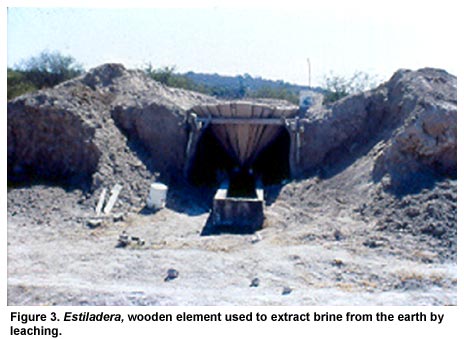
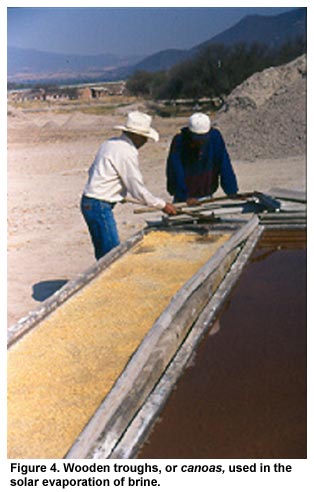
Each salt-producing unit in Araró and Simirao is known as a finca (Figure 2). The finca consists of two or more estiladeras, wooden structures that are used as filters to separate the salt from the earth by leaching. These funnel-like structures are oval-shaped at the top, and measure some 1.5 m in height (Figure 3, shown above). In every finca there are several canoas (wooden troughs, manufactured like dugout canoes, or new ones made of cement) (Figure 4, shown below) measuring between 6 and 10 m in length, where the brine that has been filtered in the estiladera is evaporated by the sun.
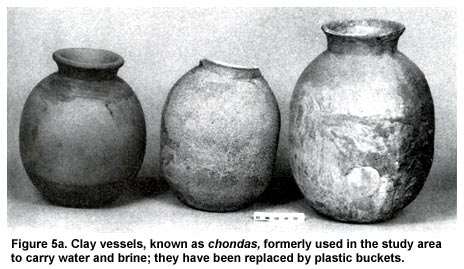
The tools used by the saltmakers or salineros are quite simple, and do not differ from tools used in agriculture or other work, such as house construction: shovels, hoes, and picks to excavate the soil, wheelbarrows to take it to the estiladera, buckets to take the water to the canoas. The tools used in the past, however, were quite different: a type of sack made of jute fiber called guangoche was used to carry the earth, and clay vessels known as chondas (Figure 5a, shown below) were used to carry the water within the finca.
The process of salt production can be divided into four stages in Araró and Simirao: (1) soils are extracted, mixed and prepared; (2) brine is obtained by leaching the earth in the estiladera; (3) brine is evaporated by the sun in the canoas and salt is collected; (4) the finished product is packed and sold. All activities linked with salt making in the study area are highly seasonal, and carried out by men only. During the dry season–from September to April–work in the fincas is carried out more intensely, ceasing entirely in the wet part of the year, when the salineros work in their agricultural fields. Rain makes it more difficult to extract the salt-bearing soil, and the greater cloud cover diminishes solar intensity for evaporation. But more important, during the rainy season abundant fresh water causes the salty soil to "lose its strength," in the words of the salineros. During the rainy season (usually from May to September, although it varies from one year to another) the saltworks are idle, and the salineros are engaged in other types of work, either inside the Lake Cuitzeo Basin or away from it. Two types of soil are used mixed together in the process of salt elaboration: tierra tirada and tierra picada, both of which are found in the finca. Tierra picada is extracted with a shovel or hoe from the top layer of soil of the finca, to a depth of ca. 10 cm. Tierra tirada is recycled from previous operations, and once its salt content is diminished after being leached, it is taken out of the estiladera and piled on top of the terrero, the mound of earth that surrounds the estiladera. After a few months, once tierra tirada has accumulated to form a big mound (up to three meters high and more than eight meters wide), it is removed with shovels and wheelbarrows, spread out on the floor of the finca, sprinkled with salty water from the springs, and is used again after soaking up the salty water for one or two days. Once both kinds of earth have been mixed in the appropriate amounts, several wheelbarrows of earth are put into the estiladera (the amount of earth used is variable, from a minimum of four to a maximum of 24 wheelbarrow loads, each one weighing ca. 100 kg). After the earth has been put in the estiladera, water from the springs is poured on top of it (the amount of water used is also variable, from a minimum of 19 to a maximum of 60 buckets), which starts trickling down and falling into the banco (a trough below the estiladera). A wooden canoa holds between four and eight buckets of water (each bucket holds 20 liters), while the new canoas made of cement hold up to 14-15 buckets of water. Approximately one bucket of brine is obtained for every wheelbarrow of earth that is put in the estiladera, or two buckets if the earth is of very high quality. The final yield is variable, but a medium-sized canoa may produce one 65-kg sack of salt every 15 days. Once the water has been filtered through the earth (this process normally takes 24 hours) and the salt has been leached, the earth is taken out of the estiladera and is piled on top of the terrero, where it will remain until it is extracted to be recycled and used again as tierra tirada. After the brine has evaporated completely in the canoa, the crystallized salt is gathered and packed. According to several informants, in the old days there was a trade network that linked Araró and Simirao with other towns in the region and beyond. Before paved roads existed, salt was transported by muleteers from one locality to another. Furthermore, the salineros themselves used to go to the markets and sell their product or exchange it for fruit or other agricultural produce. This lasted until some 50 years ago; nowadays common salt is industrially produced in mass quantities in México, and because of its relatively low price, it has replaced the salt from Araró and Simirao for domestic consumption.
|
||
|
Text links to all pages at this site are available at the FAMSI INDEX |
||