|
FAMSI © 2003: Charles Golden |
|
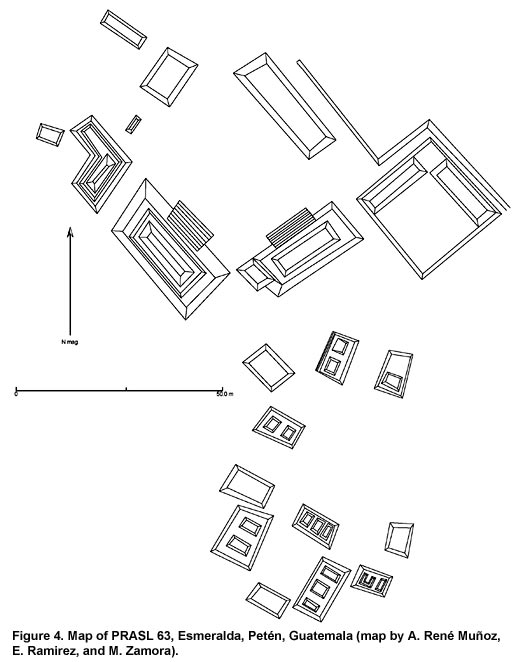
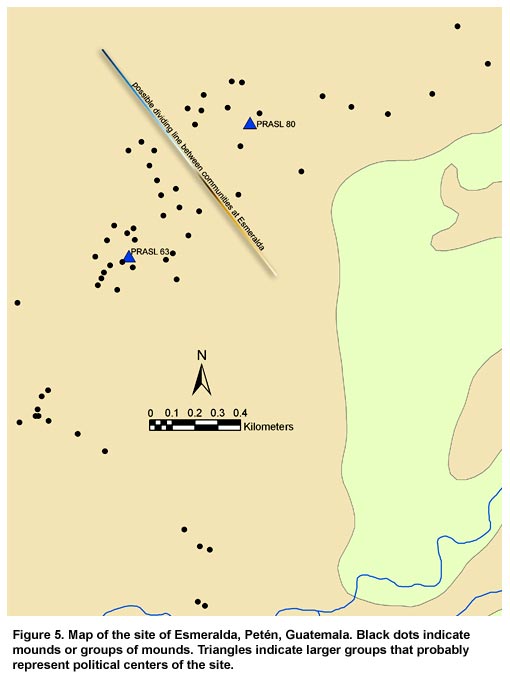
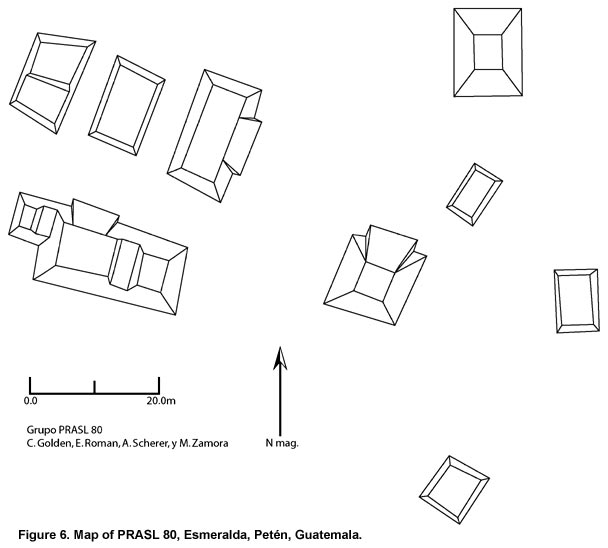
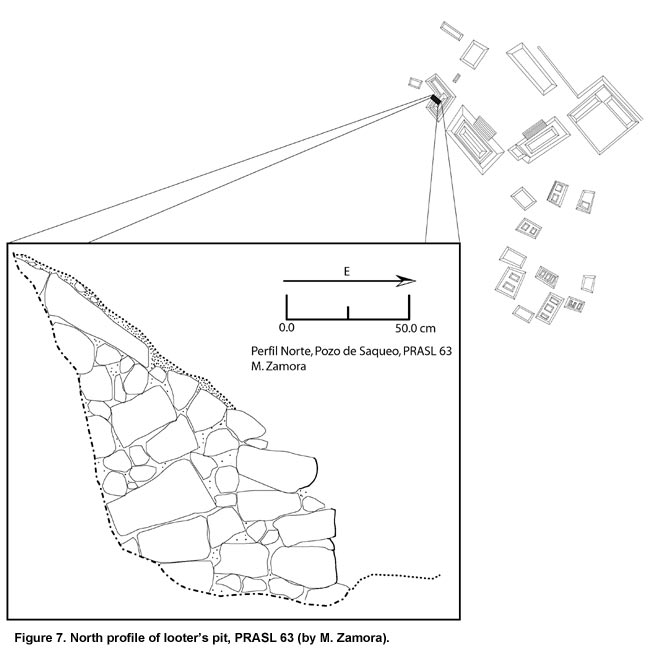
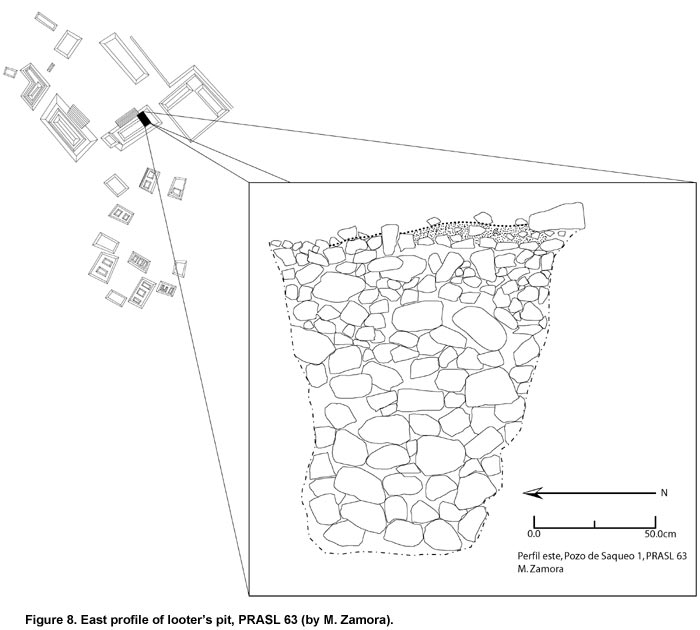
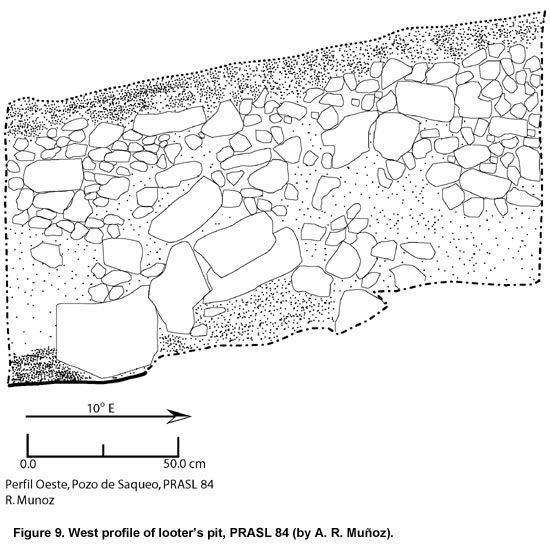
Sierra del Lacandón Regional Archaeology Project Reconnaissance of Esmeralda The site of Esmeralda is an area of dense settlement arrayed along the northern edge of a bajo extending north from the Laguneta Lacandón. Although former members of the Comunidades Populares en Resistencia en el Petén (CPR-P or Popular Communities in Resistance in the Petén) who lived in the area during the Guatemalan civil war were aware of the site, Esmeralda has not been previously reported to IDAEH or to the co-administration of the Sierra del Lacandón National Park. A grouping of approximately twenty-one structures (designated PRASL 63 3 ) is evidently the Late to Terminal Classic period political node of Esmeralda (Figure 4). Although the architecture is imposing for rural settlement, the masonry is not finely done and consists largely of a veneer of rough-cut blocks over dry-laid rubble core. If we accept as a working hypothesis that during the Late Classic period the Piedras Negras kingdom was governed by the rulers of a three tier site hierarchy (i.e., Piedras Negras as a primate center, and El Cayo, La Mar and Texcoco, among others, as secondary centers), Esmeralda appears to be a tertiary political node. Almost all other architectural groupings identified in the reconnaissance of Esmeralda consisted of one to four mounds arranged in patios. The exception to this pattern is PRASL 80, located approximately 800 m to the northeast of PRASL 63. PRASL 80 consists of nine structures arranged into a loose grouping of structures (Figure 5 and Figure 6). Among these structures are two pyramidal buildings approximately 4.00 m high, and a large (2.00–3.00 m high) range structure. The pattern of settlement suggests that Esmeralda may have been composed of two communities, with clusters around PRASL 63 as well as the smaller PRASL 80 (Figure 5). We can say from materials recovered in looter’s pits in PRASL 63 that a significant amount of architectural growth took place in that group during the Terminal Classic period (Figure 7 and Figure 8). We lack a comparative sample from PRASL 80, and therefore cannot say, at present, whether there are two contemporaneous communities. Ceramics obtained from looters pits in PRASL 63, and another group designated PRASL 84, indicate that occupation was virtually continuous at Esmeralda from the Late Preclassic through Terminal Classic periods (Figure 7, Figure 8, and Figure 9).
|
||
|
Text links to all pages at this site are available at the FAMSI INDEX |
||