|
FAMSI © 2003: Charles Golden |
|
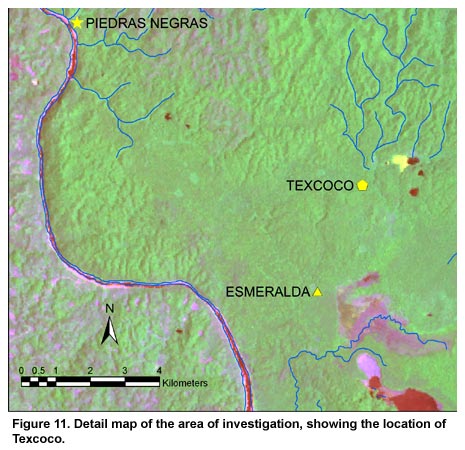
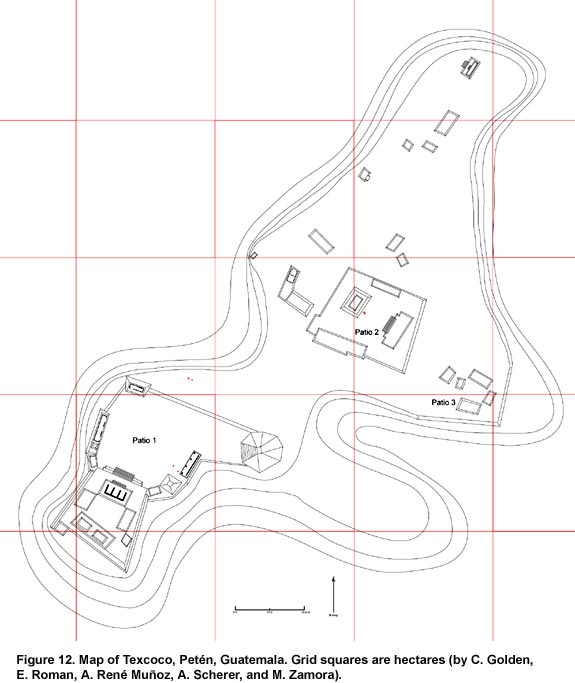
Sierra del Lacandón Regional Archaeology Project Reconnaissance of Texcoco The site of Texcoco has been tentatively identified for a century, but detailed reports by professional archaeologists do not exist (e.g., Aliphat 1994). Park guard Chico León and Archaeologist Edwin Roman rediscovered the location of the site, and project members spent two days mapping the site center with tape and compass to produce a site plan (Figure 11, shown below, and Figure 12). Given the preliminary nature of our reconnaissance, this plan is not complete, but does give a good idea of the size and nature of the site. The site center as mapped is approximately 500 m from southwest to northeast, running along a ridge top.
Access to this ridge is through a series of narrow valleys running to the southeast. The site center is dominated by the monumental architecture at the southwest end of the ridge (Figure 12). A palace complex, "La Gallina," is the focus of this area. The palace sits on a platform with three terraces, each between one and two meters high. The masonry of the structure is poorly done in comparison to that at Piedras Negras or other sites in the region, and consists of roughly worked boulders and cobbles. Seven buildings on top of a large platform form Patio 1, the plaza to the northeast of La Gallina. Of these, a pyramidal structure jutting up from an eastern extension of the patio is the largest, rising approximately 7.00 to 8.00 m on its western face and 10.00 m on its eastern face. It was impossible to define the corners of this structure, resulting in the odd form of this building in Figure 12. 4 Two uncarved column altars were found in front of a colonnaded structure northeast of La Gallina, and two more altars were located just north of Patio 1. To the northeast of Patio 1 is Patio 2. This is a smaller patio, also atop a large, low platform, composed of at least four structures, with several ancillary structures to the west, north and northeast. On the northwestern side of Patio 2 is a monumental sweatbath, similar to the eight known sweatbaths at Piedras Negras. 5 The sweatbath sits across Patio 2 from another large masonry platform, with two terraces and a staircase facing onto the plaza. Patio 2 is completed by range structures on the north and south sides of the plaza, both of which apparently held largely perishable superstructures. The southeastern corner of the southern structure provided the datum for linking the mapping data from different areas of Texcoco. 6 To the southeast of Patio 2 is Patio 3, a plaza that appears residential in nature, composed of five structures atop a large platform/terrace extending out from the hillside. Continuing northeast from Patio 2, there are a number of structures that were quickly mapped in the available time, and there are certainly more buildings than appear in Figure 12. At the northeastern end of the escarpment is a large platform with two terraces. A staircase on the northeastern side of the platform is the principal access, and a masonry wall supports give the outline of an otherwise perishable superstructure. Researchers encountered several smaller mounds in the hills surrounding Texcoco’s site center, as well as in the valley to the southeast.
|
||
|
Text links to all pages at this site are available at the FAMSI INDEX |
||