|
FAMSI © 2003: Charles Golden |
|
Sierra del Lacandón Regional Archaeology Project Reconnaissance of Tecolote The site of Tecolote probably first came to the attention of professional archaeologists in the 1930s. Edwin Shook (1998) noted in his journals that while on a trip to Piedras Negras his guides told him of standing, vaulted structures near the Chico Zapote rapids, but he was unable to visit the site due to lack of time. More secure evidence of the site came in the 1980s, when tourists presented George Stuart of the National Geographic Society with photographs of a well-preserved, vaulted structure that they had encountered on a trip down the Usumacinta River.
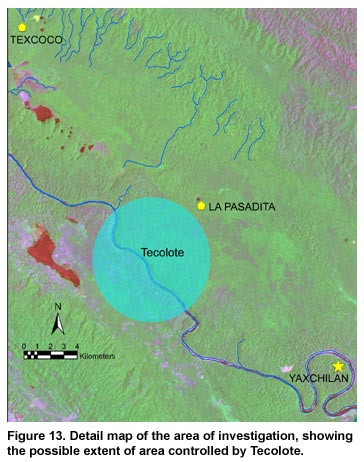
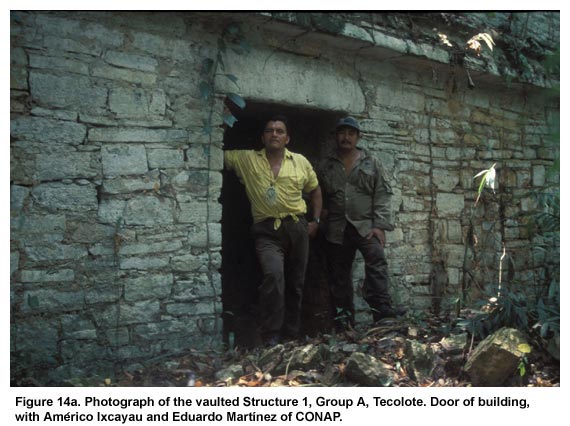
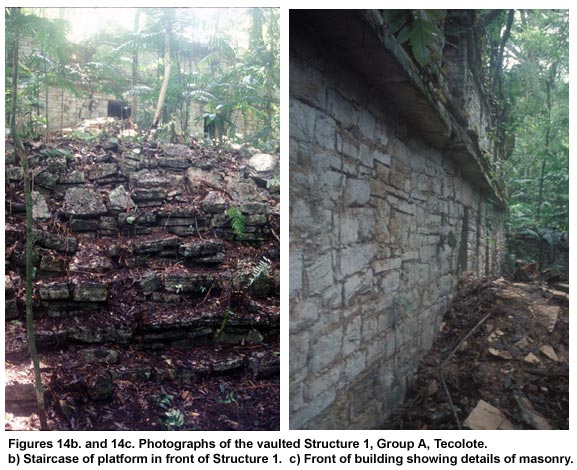
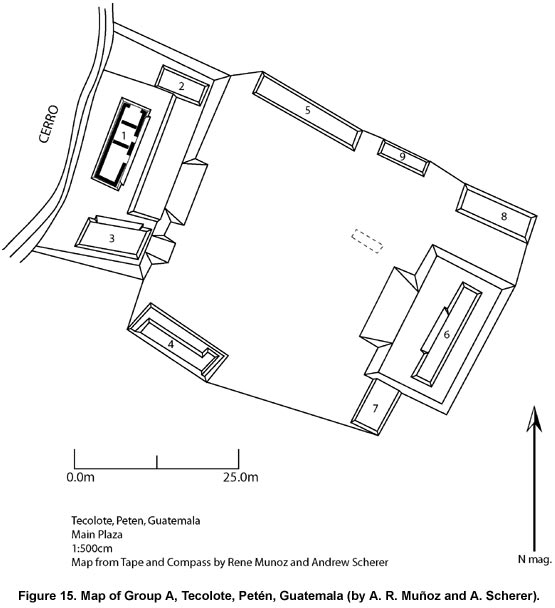
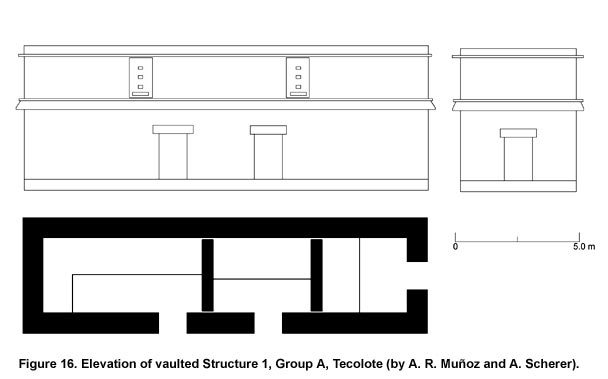
Park guards Américo Ixcayao and Eduardo Martínez led researchers René Muñoz and Andrew Scherer to Tecolote, located near the site of La Pasadita (Figure 13, shown above). This small team spent three days conducting reconnaissance and preliminary mapping of the site center of Tecolote, which includes the vaulted structure (Structure 1) that had appeared in the tourists’ photograph. A preliminary map of Group A, which contains the standing building, was made with a measuring tape and compass (Figure 14, shown below, and Figure 15). An elevation of the building was also completed (Figure 16). Due to time limitations, only sketch maps and notes were made for the remaining groups at Tecolote.
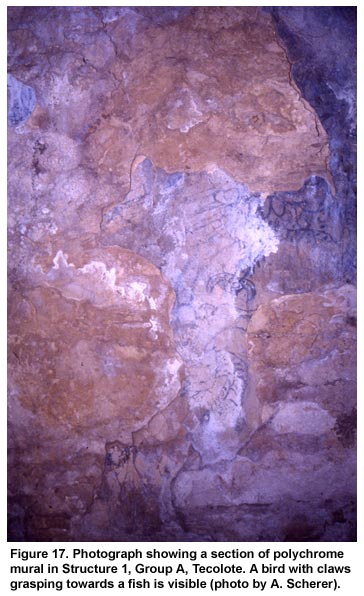
The lintels over the doorways of Structure 1 are not carved, and therefore have not been looted, which accounts for the survival of the building. Overall, Structure 1 is very well preserved. However, roots from a tree on the northeast corner of the structure have penetrated the corner of one room, and the back wall of Structure 1 is slightly bowed threatening the structure with collapse. Above the molding of Structure 1, on its front face, are two inset areas that likely housed panels or sculptures, with the sockets serving as means of mounting the piece. The inset areas are reminiscent of those found on Temple 33 at Yaxchilán, which are mounted with seated human figures. The face of Structure 1 is fronted by a small staircase, of three to four risers, which runs along the length of the building. The interiors of the three rooms are extensively looted, with the interior floors and benches largely destroyed. However, in each of the rooms, remnants of plaster are found on the interior walls and vaults, and the remains of polychrome murals are still evident. 7 The interior of this building was almost certainly covered in elaborate polychrome paintings similar to those at La Pasadita (the color palate is reminiscent of murals at La Pasadita). The majority of the paint is blue and red (specular hematite), but most individual images are no longer visible to the naked eye. However, the southwestern wall of Room 1 exhibits a small area of visible imagery near the southwest corner. A black outline of the right wing and leg of a bird is clearly visible. Below the bird are two objects, possibly fish (Figure 17, shown below). Portions of the mural are preserved in each of the rooms, with indistinct figures still visible to the naked eye. The conservation and recovery of data from these murals is a priority in future field seasons.
A looted crypt is located in the rubble fill below the floor of Room 3. The crypt is centered in the room and runs parallel to the long axis of Structure 1. The southwest wall of the crypt appears to abut the southwest wall of Room 3. The crypt measures .60 m wide, approximately 1.50 m long, and .50 m high, and was capped by 3 large, finely cut capstones, one of which was removed by looters to enter the crypt. The crypt walls consist of superbly worked stone, four courses high and covered in plaster. Preliminary exploration revealed no evidence of human remains or burial furniture, suggesting that the looters removed everything within the crypt. Adjacent to Structure 1 are Structures 2 and 3, both of which are collapsed vaulted buildings. The presence of a megalithic stone slab in the collapse of Structure 3 suggests that the building was a sweatbath, since similar architectural features are associated with sweatbaths at Piedras Negras and other Usumacinta sites–including Texcoco. A small staircase leads from the front of Structure 3 down to Patio 1. All of the other buildings in Group A, except Structures 7, 8, and 9 appear to have been vaulted, though with the exception of Structure 1 these vaults have collapsed. Located to the east of Group A is Group B. For lack of time, only very preliminary notes were taken and it was not possible to compile a map of the group. The Group has an appearance reminiscent of the acropolis at Piedras Negras, with multiple platforms approximately 5.00 m high, built into the side of a hill slope, rising in a series of patio groups demarcated by vaulted, range structures. Five other large patios or clusters of architecture where located in the vicinity of Groups A and B, and most of these contained collapsed vaulted structures. A ceramic sample obtained from a cave near Group A revealed materials spanning a range from Late Preclassic through Terminal Classic periods.
|
||
|
Text links to all pages at this site are available at the FAMSI INDEX |
||