|
FAMSI © 2004: Christopher Beekman |
|
|
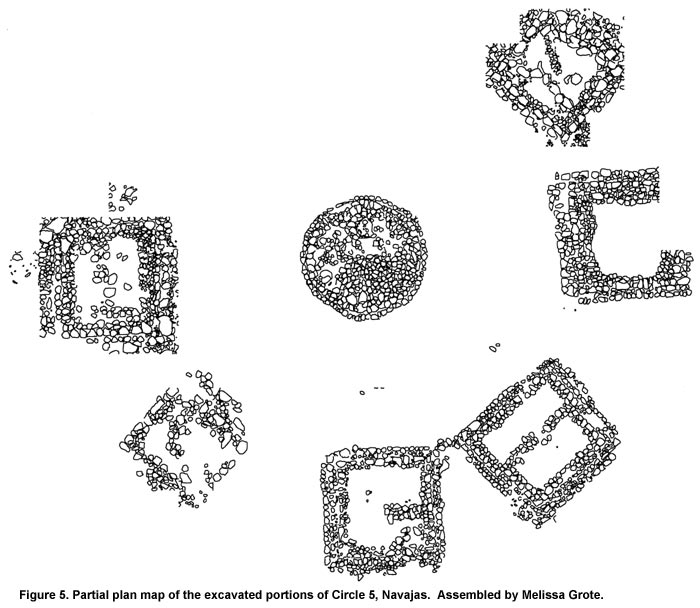
Public Architecture: Navajas, Jalisco, México Results Excavated ceramics date the circle to the Middle Tabachines phase (est. A.D. 1-200). Middle Tabachines sherds appear in all contexts, including the earliest sealed floor assemblages in three of the structures. The data from the project impact upon several issues that have interested us regarding activities within the Teuchitlán tradition circles. First, the pattern of construction at the different structures around the circle continues to support Beekman’s earlier proposal at Llano Grande that different social groups are involved in the construction of each structure. First, based on the fact that circles of the Teuchitlán tradition are not found missing one of their components, we assume that all the structures and the altar were constructed at the same time. Similar construction methods were utilized for each structure, but with variation in effort as demonstrated by differing labor investment, and variation in trajectory as demonstrated by differing construction histories. All were originally built as a stone outline with an interior floor at the same level as the surrounding ground surface. The surrounding walls were generally half a meter in height, and composed of multiple rows of stone laid side by side. Structures 5-2 and 5-7 made significant use of extremely large boulders within their walls, while Structures 5-3, 5-4, and 5-5 were built strictly with transported stones. Structure 5-6 received the least effort of the entire group, and this is very noticeable in the accompanying figure of the circle. All of these foundations would have supported perishable structures with peaked roofs (depicted nicely in the ceramic models–e.g. Von Winning and Hammer 1972: 17-21, Figures 2-5), and we found very large quantities of fired clay daub that formed the outer skin over the perishable construction. The floors of structures 5-2, 5-4, and 5-5 were later raised to a height level with the surrounding walls, making them true platforms. The other structures were left with an "empty" interior and entry must have required stepping up onto the surrounding wall and then stepping back down into the interior. Some lateral expansion of the structures may have taken place, as their side walls were often composed of parallel rows of stone laid side by side (see Figure 5), and it is difficult to determine when these were added. Many of these issues are discussed by Jennings (2004). The construction of the altar 5-9 was a microcosm of the variation noted across the circle as a whole. The basic form of the altar was of two adjacent rings of stone forming the outline, with a mixed array of fill types in the interior. Prior to adding fill to the altar, part of the interior surface was heavily burned. The fill in the southern half of the altar was carefully placed and tightly packed stone, while the northern half was a more serendipitous mixture of stone and the artificial earth mix that is commonly employed for fill. The altar therefore includes two fundamentally different fill methods in spatially discrete zones, suggesting two cooperating labor groups. Although some circles have been found to have shaft tombs directly beneath the surrounding satellite structures (Huitzilapa [Ramos and Lopez 1996], El Arenal), this was fortunately not the case with Circle 5. No burials or caches were found anywhere in the circle. Fragments of small solid figurines and even of the large hollow figures known to art historians the world over were found within several of the structures of Circle 5, demonstrating once and for all that the figures were not limited to tomb furniture, but were also used in some fashion within these surface structures. Given the argument that lineages were the social groups active within each of the structures, it seems particularly likely that the figures found in the shaft tombs represented lineage heads or similar personages. Another form of ceremonialism associated with other circles of the Teuchitlán tradition is the presence of a posthole in the center of the altar, clearly corresponding to the poles represented in PreColumbian ceramic models of the circles. As described earlier, the ceremonialism depicted seems to best correspond to something similar to the Aztec calendrical ceremony Xocotl Huetzi, probably a first fruits ritual. Altar holes have been found at Guachimontón (Phil Weigand, personal communications 2000-2003) and Llano Grande. Surprisingly, no such feature was found in Altar 5-9 in Circle 5, and the absence of this form of community ceremonialism is very interesting. One artifact class that had been less anticipated was that of carved stones. Structures 5-1 (on surface), 5-2, 5-3, and 5-4 were each associated with stones of varying sizes and with differing classes of markings on them. The most common types of markings were what we refer to as "counting marks", in which a series of parallel lines were cut into the stone, frequently adding up to numbers from 4-8. The most spectacular carvings occurred in Structure 5-2 on carved stone S4, a very large stone weighing several hundred pounds. We documented more elaborate parallel and crisscrossing markings, x shapes, and one detailed cross motif from this stone. Most of the marked stones were actually construction material built into the walls of the structures, or rubble that may have originated in a structural position. The significance of the marks is still under investigation, but studies are underway to consider the possibility that astronomical observations may be implicated. Tyndall’s examination of the ceramics has been enlightening regarding the question of group activities in the circle and especially feasting. Tyndall used the ceramic typology for the region first outlined by Galvan (1991), expanded upon by Beekman and Weigand (2000), and since modified by Beekman. For this analysis he focused on the four distinct ceramic groups from the Tabachines phases–Arroyo Seco, Colorines, Tabachines, and Estolanos.
Figure 6 represents the total weight of each group of sherds collected and catalogued from the interior of each of the six excavated structures in Circle 5 after eroded and unidentifiable sherds are removed. It clearly indicates that two types dominated the assemblage, the Arroyo Secos and the Colorines. The Arroyo Seco sherds were generally fairly thick and mostly came from vessel forms such as large basins or vats, ollas with short necks, and bowls with nearly vertical walls. Almost all of the Arroyo Seco sherds we identified fit into the sub-classification of Rojo Amplio developed by Galván to describe the sherds that had a red slip on both their interior and exterior. The next major group was the Colorines sherds that made up 35% of the entire assemblage weight. This group was easily identified by its coarse paste with numerous inclusions. This aids in firing and in maintaining internal strength. Most Colorines vessels are utilitarian and are commonly found in the form of large ollas and bowls. When decoration existed on these sherds it was typically a poorly applied red or occasionally white paint on the exterior that in some instances displays a cross-hatch design. The more highly decorated Tabachines fine wares were noticeably scarce in this collection, contributing less than 10% of the total weight. The Tabachines sherds that we found were often in such poor shape that only the fine paste, thin walls, weight, and distinctive vessel forms made it possible to identify them. The same could be said for the somewhat thicker but equally fine Estolanos sherds in this collection that only made up 1% of the total weight. Only one sherd was found that was thought to have been from an imported vessel, and hence the entire collection appears to have been produced within the region.
As Figure 7 shows, the general pattern seen across Circle 5 is largely repeated for each of the individual structures. The homogenous nature of the Circle 5 ceramic assemblage leads Tyndall to conclude that aggrandizing feasting was minimally important in this circle. The majority of the ceramics in this collection appear to have been from utilitarian vessels like ollas, bowls and serving platters that had very little decoration. Based on this, he concludes that the emergent elites were in the process of de-emphasizing local power and implementing a belief system that stressed the community over individual. The variations noted in the graph above will be examined in further detail in the coming months. The flotation and macrobotanical analysis was carried out by Bruce Benz (2004) on ten samples from Structures 5-2, 5-3, 5-4, 5-5, 5-7 and four from the patio, and present us with another angle on feasting. Numerous small friable fragments resembling the ends of long bones are common both within structures and on the patio floor. These might be the detritus of food preparation, although no faunal remains were otherwise noted during excavation. Pieces of charred maize cobs were identified in several structures, and may represent fuel although they were presumably part of the diet beforehand. Noncharred amaranthus seeds distinctive from typical modern domesticated varieties were identified from both structure (5-5 and 5-7) and patio contexts and may constitute PreColumbian remains. The very limited occurrence of large Chenopodium seeds on the floor of Structure 5-5 would appear to predate the next earliest known occurrence of this species in Mesoamerica at Early Classic Teotihuacán. Chenopodium is used as a medicinal or flavoring herb today. The macrobotanical remains at Circle 5 do not represent an extraordinarily diverse set of species, and if feasting was taking place within the circle, we might expect that other foods, quite possibly pulque as suggested by Butterwick (1998), were on the menu. Finally, the light presence of charred wood fragments throughout the circle suggests that the area was maintained and swept regularly. In terms of the variation within Circle 5, there are distinctions both between the patio and the structures, and between structures. To begin with, patio units are diverse in their assemblages. Structure floors differ from the patios in their greater number and variety of types of organic remains (seeds, wood, cob fragments), as one might expect within enclosed spaces, although Benz cautions that even the charred remains need not necessarily be part of the PreColumbian occupation. Structures vary considerably one from another, with maize in 5-2, 5-4, and 5-5, and Chenopodium in 5-5. Structures 5-3 and 5-7 seem to have been comparatively impoverished in macrobotanical remains, and Structure 5-5 seems to have had the greatest number and abundance of charred or non-charred putatively PreColumbian culturally relevant species. Diversity and intensity of activities seems most evident in Structure 5-5, which was also one of the more elaborately built structures, and is the only structure in which a metate was found seated directly atop the final floor. Although only a preliminary analysis of the lithics has been completed at this point, there are rather clear distinctions in the stone tools found in the different structures with, for example, scrapers occurring in elevated quantities in Structure 5-7. This would seem to more clearly indicate different activities within the different structures, and future work needs to focus on these materials. The flotation analysis found obsidian microliths to be ubiquitous throughout both patio and structure floor samples, suggesting that lithic production took place within and around the structures. |
||
|
Text links to all pages at this site are available at the FAMSI INDEX |
||