|
FAMSI © 2005: Marcie L. Venter |
|||||||||||||||||||||||||||||||||||||||||||||||||||||||||||||||||||||||||||||||||||||||||||||||||||||||||||||||||||||||||||||||||||||||||||||||||||||||||||||||||||||||||||||||||||||||||||||||||||||||||||||||||||||||||||||||||||||||||||||||
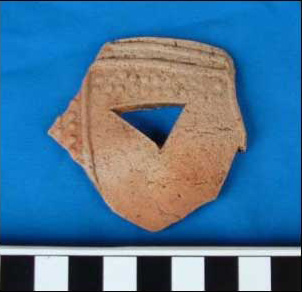
Totógal: Investigations of Postclassic Occupation and the Aztec Frontier in the Tuxtla Mountains, Veracruz, México Artifacts Fieldwork at Totógal recovered approximately 27,000 ceramic sherds, 458 flaked-stone artifacts, and 11,912 grams of burned clay fragments from systematic shovel-tests, opportunistic surface collections, and excavations. Shovel-testing recovered 172 flaked-stone artifacts; 8556 ceramic sherds; and 3033.8 grams of burned clay, 573 grams of which contain diagnostic architectural characteristics. We recovered materials from nearly all parts of Totógal except at the peripheries where declining artifact frequencies within shovel-tests were used to determine the approximate limits of the site. 4 Places with architectural features yielded the greatest quantities of artifacts; as noted above, however, the types of architectural units vary. Excavations placed in surface artifact concentrations or near architectural features yielded the remainder of materials. Most deposits were one meter or less in depth. Only those in the Arroyo Complex were deeper. Preliminary analysis of materials supports a Late Postclassic (A.D. 1350-1521) date for Totógal’s principle occupation even though we found earlier materials and there is substantial continuity in ceramic pastes from the Classic period. Ceramics All encountered ceramics (rims and body sherds) were collected. Few Formative period diagnostics were identified. The Formative period occupation appears to have been small and disperse with Formative ceramics found in both Fields A and B. A more systematic study of Field A in the future will better define the early occupation. Some Classic period Fine Gray (untempered) bowl forms were recovered. We also found a few examples of Coarse Orange, a Tuxtlas ware that carried over from the Classic into the Early Postclassic period (Arnold and Venter 2005). Untempered Fine Orange ceramics, previously thought to occur in highest proportions during the Middle Classic period (Santley and Arnold 1996), are often decorated with Late Postclassic motifs at Totógal. Common designs include step-frets and triangles etched into a black painted rim band like those on Tres Picos II pottery in the central Gulf Lowlands (Medellin Zenil 1960:155; see also Arnold 2003: Figure 7). At least 31% of all decorated ceramics contain motifs characteristic of this tradition. Ongoing motif analysis may increase this percentage. Continued study of Totógal’s ceramic decoration and vessel forms will better distinguish temporal phases. Because most Late Postclassic decoration is on untempered pastes similar to Classic period wares, motif styles and vessel forms will likely prove the best tools to discriminate chronological patterns. In addition to Gulf Lowland styles, we recovered several fragments of Texcoco-Molded censers and molds, thought to be a marker of Aztec imperialism (Garraty and Stark 2002; Ohnersorgen 2001; Umberger 1996) (see Figure 8, shown below). Their distribution is ubiquitous, but quantities vary by location. Ceramics of this type make up 10% of all decorated sherds and are usually of a fine to medium sand-tempered brown to orange paste. Combined, Texcoco-Molded and Tres Picos II-style pottery account for at least 41% of all decorated ceramics at Totógal. The proportions of these decorative styles suggest that a significant proportion of the occupation at Totógal belongs to the Late Postclassic.
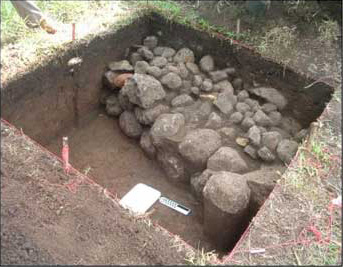
While elaborately decorated ceramics are ubiquitous, two areas in particular yielded higher proportions; the main platform in the Muros Zone and the Arroyo Complex. Some of the best examples of Tres Picos II-style pottery were encountered during our cleaning and profiling of looters’ pits. Likewise, the surface of the buried wall (Figure 7) mentioned above yielded this ceramic style and Texcoco-Molded pottery, suggesting that this architectural feature was used during the Late Postclassic. We have not identified Classic or Early to Middle Postclassic period diagnostics from on top of these walls.
In the other area that yielded especially high proportions of Late Postclassic diagnostic ceramics, the Arroyo complex, we placed two excavation units and a trench. The 1×2 m (west to east, 2 m deep) trench, placed at the eastern foot of the small conical mound, yielded nearly 3000 pieces of pottery, 40 pieces (25.3 grams) of obsidian (green=19 [14.1g], clear/clear w/inclusions=7 [2.8 g], black/dark gray=14 [8.4 g], other=1 [.1 g]), a roller stamp 5 and a spindle whorl (Figure 10, shown above). Preliminary analysis of materials from this mound suggests Late Postclassic construction and occupation: diagnostic Late Postclassic ceramics, Aztec imperial-style Texcoco-Molded censer fragments and Late Postclassic Gulf Lowland decorated ceramics (e.g. Tres Picos II-style [Figure 11, shown below]), occur in the plow zone as well as the six strata identified during excavation. These decorated sherds are found in mixed deposits that contain Postclassic and Classic period ceramics: wares include Fine Orange, Fine Gray, and Coarse Orange. The Tres Picos II-style and Texcoco-Molded sherds in each stratum suggest Late Postclassic mound construction, but the fill used may incorporate ceramics from earlier occupations. Because this is an enclosed, low-lying, flood prone area, it may have been desirable to create raised surfaces. The amount of alluvial fill in an excavation unit to the immediate southeast of this mound supports this explanation. That unit yielded deeply buried Late Postclassic ceramics that had been covered by a thick layer of nearly sterile alluvium. It appears as though the Late Postclassic occupants of the area initially settled closer to the arroyo then moved northward away from it where they used surrounding fill to construct the mound.
Obsidian All flaked-stone artifacts at Totógal were made from obsidian (Table 1). Prior Instrumental Neutron Activation Analysis conducted on obsidian at other Gulf Lowland sites shows a strong correlation between visual color categories and source material so that green corresponds to Pachuca, clear/light gray to Pico de Orizaba, 6 and black/dark gray correlates to Zaragoza-Oyameles (Heller and Stark 1998; Santley et al. 1991; Stark et al. 1992). Survey and excavation recovered production indicators as well as finished prismatic blades and projectile points. Production debris includes macrodebitage and core fragments of both green and black obsidian. Production debris and prismatic blade fragments are both found in the various parts of the site. While no strong clustering occurs in surface collections based on source consumption, counts vary. Green obsidian has the most extensive distribution and is present in portions of the site where frequencies of other sources are lower. The lower frequency or absence of non-green material is likely related to the extent of occupation during different temporal phases and not to differential access within the site.
Average weight per specimen varies dramatically by source. As Table 1 indicates, the average weight per item for clear and black/dark gray (including probable Zaragoza-Oyameles) obsidian is substantially lower than the ratio for green obsidian and material that may source to Pico de Orizaba (source code 4, Guadalupe Victoria). All categories contain both prismatic blades and production debris so differences there should not be cause for this pattern. Likewise, we recovered core fragments of both black and green obsidian (both of whose weights skew the mean upward), equalizing the effects of outliers on these ratios. Blade size may relate to smaller core size for positively identified Pico de Orizaba obsidian (Heller and Stark 1998:125). Larger size for blades and debitage of probable Pico de Orizaba material may reflect a temporal difference in source access, core size or the unlikely possibility that this material is not from Pico de Orizaba. For black obsidian, low comparative weight per specimen is uncharacteristic: this could mean breakage rates were higher and imply functional differences. More in-depth analysis will clarify this. The obsidian data at Totógal are mostly characteristic of Postclassic trends elsewhere in the Gulf Lowlands (Arnold 2003; Arnold and Venter 2005; Heller and Stark 1998; Ohnersorgen 2001); however there are a few striking differences. Compared to Isla Agaltepec, which has roughly 60% clear obsidian, the proportion at Totógal is much lower at 24.2% (24% by weight). The amount of clear obsidian is also low in comparison to central Gulf Lowland Postclassic sites (Heller and Stark 1998). In contrast to several Gulf Lowland sites, the proportion of green obsidian at Totógal is substantially higher at 40% (49% by weight), even higher than Cotaxtla, an Aztec provincial capital that was closer to the Central Highlands ([20-30%] Ohnersorgen 2001). The proportion of green obsidian at Totógal is more like Late Postclassic sites in the Mixtequilla were Pachuca material comprised roughly 43% of collections (Stark 1990:269). The high proportion of black/dark gray obsidian ([count = 34%], [weight in grams = 26.4%]), suggests a substantial Classic period occupation. A technological trend observed at Gulf Lowland Postclassic sites (Arnold 2003; Arnold and Venter 2005; Heller and Stark 1998) is the grinding of platforms. We recorded 74 platforms at Totógal: 40 are ground (Table 2). Platform grinding is differently associated with artifact type and material source. Most platforms are on finished prismatic blades, but some are from core reduction debris. All green and clear platforms are ground, while most black platforms are not. Platform treatment and its correlation with source material suggest that Classic and Early Postclassic period occupations preceded the Late Postclassic at Totógal. The clear obsidian and clear ground platforms suggest a Postclassic date, but it is uncertain if the material was associated with an earlier Postclassic population or with the Late Postclassic. At Isla Agaltepec, the highest proportions of clear obsidian are from Early Postclassic contexts (Arnold 2003). At Totógal, the fact that both ground and unground platforms occur nearly equally on both clear obsidian and clear obsidian with inclusions may reflect the transition from Classic to Early Postclassic technologies and source utilization. Population decreases during the early portions of the Postclassic have been noted for other parts of the Tuxtlas (Killion and Urcid 2001; Santley and Arnold 1996) and this trend may be reflected at the site by the lower-than-expected amount of clear obsidian. Nevertheless, there is only a slight decline in clear obsidian compared to black material, suggesting at relative stability during the Classic-to-Postclassic transition, unlike other sites in the Tuxtlas (Santley and Arnold 1996).
Although the ways regional population trends affected Totógal remain to be fully explained, by the Late Postclassic it appears there was population growth at the site. While we should not assume that the Late Postclassic inhabitants did not use black obsidian or that green obsidian was not used during the Classic period, platform grinding and a lower-than-expected proportion of clear obsidian suggest that the Late Postclassic occupants used green obsidian almost exclusively, especially if we allow for an earlier Postclassic occupation that imported clear obsidian. That Totógal was not importing the closer clear Pico de Orizaba obsidian to the same extent as its Late Postclassic Gulf Lowland contemporaries suggests that the site’s occupants had different access to central highlands exchange networks and relied heavily on them to supply this material. A reliance on central highland obsidian could relate to Toztlan’s ethnohistorically documented imperial connections that may have made the community reliant on its obsidian exchange networks. The high proportion of green obsidian could also relate to Toztlan’s proximity to isthmian trade corridors, which imperial pochteca merchants likely traversed (Carrasco 1999). Other Gulf Lowland sites with documented imperial ties showed a marked increase in green Pachuca source material during the Late Postclassic (Heller and Stark 1998; Ohnersorgen 2001). These obsidian data, together with imported ceramic decoration styles, suggest that fairly direct and frequent interactions characterized Totógal/Aztec relations.
|
||||||||||||||||||||||||||||||||||||||||||||||||||||||||||||||||||||||||||||||||||||||||||||||||||||||||||||||||||||||||||||||||||||||||||||||||||||||||||||||||||||||||||||||||||||||||||||||||||||||||||||||||||||||||||||||||||||||||||||||||
|
Text links to all pages at this site are available at the FAMSI INDEX |
||||||||||||||||||||||||||||||||||||||||||||||||||||||||||||||||||||||||||||||||||||||||||||||||||||||||||||||||||||||||||||||||||||||||||||||||||||||||||||||||||||||||||||||||||||||||||||||||||||||||||||||||||||||||||||||||||||||||||||||||