|
FAMSI © 2007: Mónica Alejandra Pérez Galindo |
|
Dieseldorff Collection: Ceramic Corpus of the Terminal Classic Originating from Molds
Research Year: 2004 Table of Contents
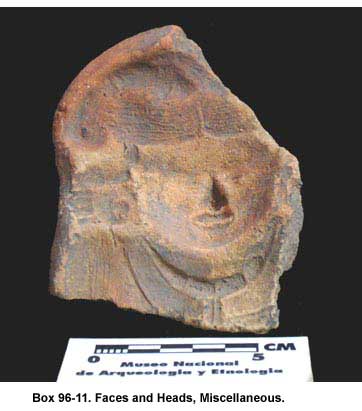
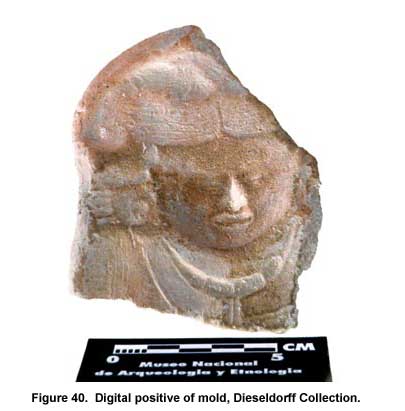
Abstract The region of Las Verapaces, which includes the Departments of Alta Verapaz and Baja Verapaz, in Guatemala, shows evidence of its interaction with the Mayan lowlands and the Guatemalan plateau through the iconography observed in its ceramics. In spite of its strategic position, this region has not been studied in depth, and it is because of this that there are still questions regarding the local ceramic sequences and the iconographic patterns. Therefore, it is no wonder the first explorers of the zone were the German coffee growers, who, during the nineteenth century and the beginnings of the twentieth, made important findings on their farms, achieving invaluable archaeological collections as a result. Considering the richness of this material, the present project financed by FAMSI has, as its objective, the documentation of a sample of the ceramics from the Terminal Classic (830-900 A.D.) that were made by the use of molds and are part of the Erwin Paul Dieseldorff Collection, which is situated in the National Museum of Archeology and Ethnology in Guatemala. La región de las Verapaces, que comprende los departamentos de Alta Verapaz y Baja Verapaz, Guatemala, muestra a través de la iconografía observada en su cerámica, evidencia de interacción con las Tierras Bajas Mayas y el Altiplano guatemalteco. Pese a su posición estratégica, esta región aún no ha sido estudiada a profundidad, por lo que aún se presentan interrogantes en las secuencias cerámicas y los patrones iconográficos locales. Por tanto, no es de extrañar que los primeros exploradores de la zona fueran los cafetaleros alemanes, quienes durante el siglo XIX y principios del XX, realizaron importantes hallazgos dentro de sus fincas, logrando así conformar invaluables colecciones arqueológicas. Considerando la riqueza de este material, el presente proyecto financiado por FAMSI tiene como objetivo documentar una muestra de cerámica del Clásico Terminal (830-900 d.C.), proveniente de moldes, que es parte de la Colección del Sr. Erwin Paul Dieseldorff, la cual se alberga en el Museo Nacional de Arqueología y Etnología de Guatemala. Click to download the report in PDF format: Dieseldorff Collection: Ceramic Corpus of the Terminal Classic Originating from Molds (Text and Images) (67.7 MB) The PDF files require Adobe Acrobat Reader.
Submitted 02/24/2005 by: |
||
|
Text links to all pages at this site are available at the FAMSI INDEX |
||