|
FAMSI © 2005: Andrew R. Wyatt |
|
Excavations on Agricultural Terraces: Results of the 2004 Field Season at Chan, Belize
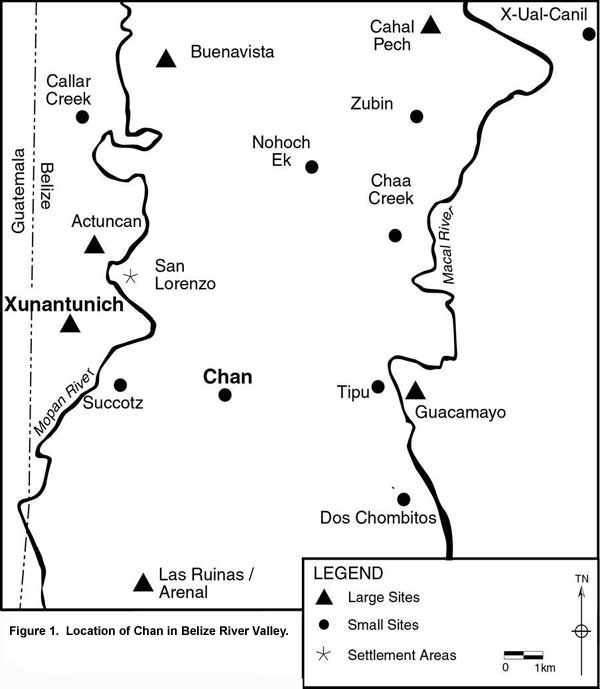
The Chan Site: Location, History, Previous Research The archaeological site of Chan is located in the Belize River Valley in the Cayo district of western Belize (Figure 1, shown above). This area lies within the Central American Neotropics sharing many characteristics with the region as a whole, including much of the flora and fauna, seasonal wet and dry periods, and dense semi-deciduous and evergreen forests (Wright, et al. 1959: 13-33; West 1964). The gently rolling hills, rich soils, and fertile flood plains of the Belize River Valley – extending in some areas up to 1 km from the course of the Belize River – have produced an environment well-suited to agriculture. The western Belize River Valley in particular, lying within the foothills of the Maya Mountains, is a hilly environment and provides an excellent environment for agricultural terrace construction. Indeed, this area contains one of the highest regional densities of agricultural terraces in the Maya area. The first large-scale settlement survey in the Maya area was undertaken in the Belize River Valley at Barton Ramie, a small rural settlement located on the banks of an oxbow lake on the Belize River (Willey et al. 1965). Since Willey's pioneering survey in the late 1950s, numerous settlement surveys (Ashmore et al. 1994; Ford and Fedick 1992) have made the Belize River Valley one of the most intensively surveyed regions in Central America. Household excavations, in conjunction with these surveys (Ashmore 1996; Robin 1996), have also contributed a great deal to our understanding of rural Maya society. The Chan site is a small, ancient Maya farming village. It is located approximately 4 km southeast of Xunantunich in the upland terrain between the Macal and Mopan drainages of the Belize River in western Belize. Occupied from the Middle Preclassic period to the Early Postclassic period (900 B.C.–1200 A.D.), Chan's period of highest population and intensive land use was during the latter part of the Late Classic period (A.D. 670-780) (Robin 1999). Chan's density of agricultural terracing and rise in population during the fluorescence of the Xunantunich polity suggest its function as a center of agricultural production (Robin 1996).
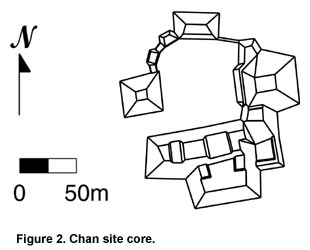
The Chan site was first identified during the settlement survey of the Xunantunich Archaeological Project by Dr. Cynthia Robin (Figure 2, shown above). Initial household-focused work at the Chan site was carried out in 1996 at a cluster of farmsteads lying to the south of the site center (Robin 1999). In 2002 and 2003, a survey of the entire Chan site, an area encompassing 1 km2 surrounding the site core (defined using nearest-neighbor analysis [Ashmore et al. 1994]) was completed. The findings of the final 2003 survey season at Chan documented a concentration of terraces greater than any in the Belize River Valley (304 km2 [Wyatt and Kalosky 2003]), revealing an exceptional level of landscape alteration unique in the Maya region. Contour terraces are the most widespread type of agricultural construction at Chan with over 89% of the total. This type of terrace transforms a hillside into a series of stepped, level planting surfaces, providing erosion control and water management (Donkin 1979: 32). Many of the contour terraces at Chan are exceptionally well preserved and exhibit a wide variety of sizes and locations. Terrace walls range in height from less than 50 cm to over 2 m and correspond to hillslopes of very gentle grades of 5º to steep grades of 35º. Contour terraces are often found adjacent to large household structures as well as far from any visible housemounds. Cross-channel terraces make up 2% of the total number of terraces. Cross-channel terraces are made up of a series of steps built horizontally across a seasonally inundated channel or gully, trapping sediments and providing very rich soils (Donkin 1979: 32). Due to the accumulative nature of cross-channel terraces, their walls are often quite high, with some at Chan as much as 3.5 m in height. Although only a small percentage of the total number of terraces, their size often make them a prominent feature of the landscape where they are found. Cross-channel terraces are often considered organizationally different in terms of construction and maintenance compared to contour terraces (Dunning and Beach 1994; Fedick 1994), yet at Chan we find these two types of terraces adjacent to and even connected to one another. This suggests that our models of terraces and the organization needed to construct and maintain them are not yet complete. |
||
|
Text links to all pages at this site are available at the FAMSI INDEX |
||