Image - Cacao Pod Vessel - K6706 © Justin Kerr FAMSI © 2001:
Christina M. Elson
 

Excavations at Los Mogotes, San Martín Tilcajete, Oaxaca:
A Terminal Formative Subregional Center in the Valley of Oaxaca
Vea este informe en Español.
Printable version

Figure 1. The San Martín Tilcajete Area

Research Year:  2000
Culture:  Zapotec
Chronology:  Terminal Pre-Classic
Location:  San Martín Tilcajete, Oaxaca, México
Site:  Los Mogotes

The site of Los Mogotes, located near the modern town of San Martín Tilcajete, Oaxaca, was identified by the Oaxaca survey team (Kowalewski et al., 1989) as a regional center for the Zapotec state in Period Monte Albán II (100 B.C. - A.D. 200). Los Mogotes predecessors, El Mogote (a chiefly center occupied from 700-300 B.C.) and El Palenque (established ca. 300 B.C.) have been the focus of investigations by Charles S. Spencer and Elsa M. Redmond of the American Museum of Natural History (Figure 1). Their project includes mapping, surface collections, and excavations (Spencer, 1999). At El Mogote and El Palenque, Spencer and Redmond have excavated residential and public buildings. They note that when the administrative core shifted from El Mogote to El Palenque, the residents invested a great deal of energy in building elite residences and public buildings around the new plaza. Yet, El Palenque’s occupation was short-lived. By 100 B.C., Los Mogotes took over regional center status from El Palenque. Located on a ridge above El Palenque, Los Mogotes is 18 km away from and has a direct line of sight to the state capital, Monte Albán.

Figure 2. Los Mogotes site based on a topographic map by C. Spencer and E. Redmond

In 1993 and 1994, Spencer and Redmond mapped and intensively surface collected Los Mogotes (Figure 2). The surface data show that a section of the site centered around Plaza II has public buildings, residences, and residential terraces with exclusively Period II occupation. Associated with Plaza II is an ancient roadway that Spencer and Redmond’s intensive surface collections date to the Terminal Formative. The road climbs up from the valley floor and traverses the site.

My first season of excavation (July-September, 1999) at Los Mogotes, uncovered an elite residence on the north side of the Terminal Formative Plaza (Plaza II). This residence, Structure 1, was built on a 12 x 12 m platform and consisted of six to eight rooms around a central patio. Deposits from the structure had abundant red or black slipped creme paste wares, some incised, and "yellow" paste wares. These kinds of ceramics are good Period Monte Albán II diagnostics and are often associated with elite contexts. The structure also contained abundant obsidian, shell, and mica.

FAMSI funds were used to complete a second five weeks of excavation (July 17-September 1, 2000) at Los Mogotes. The 2000 excavation season focused on a building located on the east side of the Terminal Formative Plaza and on a large terrace with the remains of a house foundation located just east and down slope from Plaza II.

Preliminary data from the two excavation seasons include plans and photographs of the structures and a field analysis of the associated artifacts. A full analysis of all the excavated material from Los Mogotes will take place during a lab season in July and August of 2001. At present, it is only possible to offer preliminary conclusions regarding the nature of the excavated structures.

Figure 3. Preliminary Plan of Mound B, Structure 2

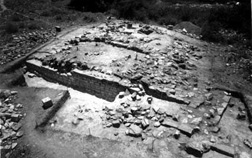
The mound on the east side of the Terminal Formative Plaza was designated Mound B (Figure 3, shown above and Figure 4, shown below). Here, horizontal excavations exposed 138.5 m2 and the remains of a structure, Structure 2, built atop a large platform. The platform itself would have measured 11 m (N-S) by 14 m (E-W) and incorporated substantial retaining walls on the west, south, and east sides to build up and level off the natural slope of the terrain. The west retaining wall (facing the plaza) stood almost 1 m tall and was constructed of 5-6 courses of nicely-faced stone blocks. Erosion and plowing had destroyed the floors and an ancient looting pit had badly damaged the north-east corner of the structure; however, I obtained an almost complete plan of the building. Structure 2 was oriented 22 degrees east of north, probably entered from the plaza, and consisted of two rooms, positioned one behind the other. The interior of Room 1, the "outer" room (since it is the first room that would have been entered from the plaza), measured 3.2 m (N-S) by 5.2 m (E-W). The interior of Room 2, the "inner" room, measured 3.8 m (N-S) by 5.2 m (E-W). Centered against the back (east) wall of Room 2 was an 80 cm by 80 cm square made of cut flagstones whose base was found 50 cm (six levels of flagstones down) below the level of the remaining wall foundations. Following Flannery’s (1998) review of the ground plans of early states, a preliminary interpretation of the plan of Structure 2 is that it may have served as a two-room temple.

Figure 4. Mound B, Structure 2, Looking Northeast

Attached to the north side of Structure 2 was a platform that would have linked Mound B with the base of Mound A (the location of the elite residence excavated in the 1999 field season). Time constraints did not allow me to excavate this platform in its entirety. Excavation did determine that the platform measured 7 m (E-W) and probably would have stretched 12 m along the N-S axis to link it to the base of Mound A.  On top of the platform were the remains of a 6 cm thick plaster surface. Possibly, this platform was constructed first and Mound B and Structure 2 were later additions. A pit placed along the south side of the south wall of the platform uncovered a nine-course nicely-faced wall almost 2 m high. This wall was later incorporated into Structure 2 as the north wall of the building.

There was little ceramic material associated with Structure 2. Most of the ceramic material was very fragmentary and came from the fill of the platform. The presence of fragments of gray bowls with combed bottoms is consistent with the surface data that dates the construction to the Terminal Formative Period; however, this preliminary analysis will be evaluated during the upcoming season of lab work.

Area C was located east of Area B on a terrace which was easily accessed only from the east side of the plaza. Here, I exposed 147 m2 and located the remains of a probable domestic structure, Structure 3, which was oriented 22 degrees east of North. Structure 3 exhibits several construction phases. Because the floors were not well preserved, it is a bit difficult to determine the original layout of the building. Structure 3 measured at least 11 m (E-W) by 8.5 m (N-S). Part of the initial building was a massive central wall 1 m thick and 10 m long constructed partially of well-cut stone and partially of large square adobes (some measuring 50 cm by 30 cm). One room, possibly the north west room of the structure, measured 3.2 m by 3.2 m. The exterior walls of this room were 80 cm thick and made of nicely-faced stone. There may have been 3 to 4 or more rooms either arranged around a patio or attached to an open platform space. The rubble of the structure contained fragments of plaster and plastered adobes.

Domestic material such as manos, metates, ollas, and comales was found in the fill of Structure 3. Shell, mica, and obsidian also were found in the structure. Off the east side of the structure a midden was located containing charcoal, ash, large sherds, figurine fragments, and animal bone. Laboratory analysis of the fill from Structure 3 and the midden will help determine the kinds of activities that took place here.

Thus far, excavations at Los Mogotes have made considerable contributions to our knowledge of the kinds of residential and administrative structures found at a Monte Albán Period II regional center. At present, it is possible to draw some broad conclusions about transformations in the local administrative structure by comparing Los Mogotes with its predecessor, El Palenque. For example, Spencer and Redmond report that buildings at El Palenque are oriented 17 degrees east of magnetic north, while the buildings at Los Mogotes follow a distinct orientation of 22 degrees east of magnetic north. Both El Palenque and Los Mogotes have elite residences on the north side of the plaza and temples on the east side of the plaza; however, the elite residence at El Palenque was at least 16 x 16 m in dimension (which does not include platforms and auxiliary structures attached to the residence) while the elite residence at Los Mogotes measured only 12 x 12 m. There is a real paucity of shell, mica, and obsidian at El Palenque which appear in abundance at Los Mogotes. One possible explanation for these data are that before 100 B.C. this branch of the Oaxaca Valley was not integrated into the Monte Albán state (Spencer and Redmond, 2001) and Monte Albán blocked access by the local population to exotics such as obsidian, shell and mica. Only after the site was politically incorporated into the Zapotec state did its administrators have access to elite ceramics and exotic goods.

An in-depth analysis of the data from mapping, surface collections, and excavations is necessary before a detailed picture of the relationship between Los Mogotes and Monte Albán can be presented. Once we have constructed a detailed history of the San Martín Tilcajete region, we suggest what kind of administrative structure was established at this secondary center. Then, by comparing and contrasting this data with data from Monte Albán and regional centers such as San José Mogote in the Etla branch, we can suggest what kind of strategies Zapotec rulers used to attain and maintain political and economic control over local elite in different regions.

Sources Cited

Flannery, Kent V.
1998 The Ground Plans of Archaic States. In Archaic States, edited by G. M. Feinman and J. Marcus, pp. 15-58. School of American Research, New Mexico.
Kowalewski, Stephen A., Gary M. Feinman, Laura Finsten, Richard E. Blanton, and Linda M. Nicholas
1989 Monte Albán’s Hinterland, Part II: Prehispanic Settlement Patterns in Tlacolula, Etla, and Ocotlán, the Valley of Oaxaca, México. Memoirs of the Museum of Anthropology University of Michigan, No. 23, Ann Arbor.
Spencer, Charles S.
1999 Palatial Digs. Natural History 108 (5):94-95.
Spencer, Charles S. and Elsa M. Redmond
2001 Multilevel Selection and Political Evolution in the Valley of Oaxaca 500-100 B.C. Journal of Anthropological Archaeology (in press).

Submitted 03/19/2001 by:
Christina M. Elson
celson@amnh.org

For related information see the report submitted to FAMSI by Elsa M. Redmond: Excavations at El Palenque, San Martín Tilcajete: A Late Formative Subregional Center in the Oaxaca Valley, México.

Return to top of page