|
FAMSI © 2004: Ronald A. Castanzo |
|
Tepeaca Kiln Project Conclusion The results of the first season of the Tepeaca Kiln Project demonstrate the great promise of the study of kiln remains in the Tepeaca region. Many features can easily be confirmed as being pit kilns probably dating to prehispanic times. However, many more kilns were apparently used in lime processing as opposed to ceramic production than thought prior to the 2003 season (although this is not surprising given the known sources of lime in the immediate vicinity) and these kilns have very little if anything in the way of surface artifacts. A sensible approach to the future study of local lime kilns would be to use radiocarbon dating on carbonized tepetate prior to excavation so that valuable field time is not wasted on potentially post-Contact features.
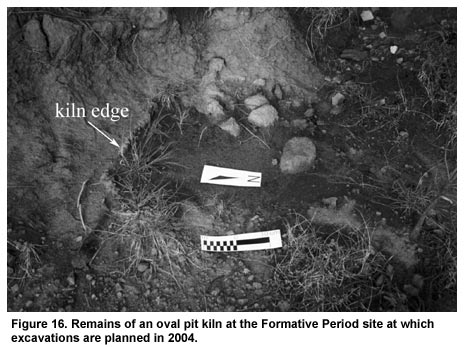
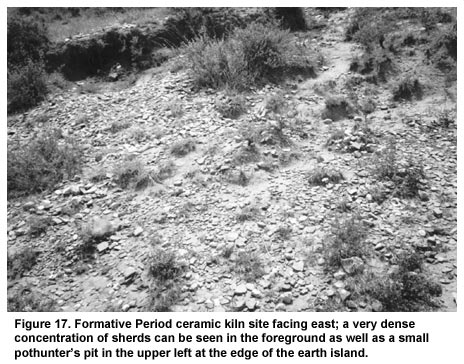
Funding is currently being sought for the extensive excavation of the Formative Period ceramic production site located on Cerro Tlaquexpa in the summer of 2004. Time was not available in the 2003 season to adequately investigate or excavate this site. The site is an approximately 2,000 m2 island of earth, approximately 50 cm in depth, on the exposed tepetate of the hillside. The remains of seven kilns (Figure 16, shown above) have been found at the edges of this island in addition to very high densities of Formative Period potsherds (Figure 17, shown below). In one instance (K63), half of the kiln rim is exposed, the other half still buried beneath 50 cm of earth. In addition to the excavation of the Formative Period pottery production center, funding is also being sought for INAA on sherds collected by PAT now being curated in Puebla, México, by the Instituto Nacional de Antropología e Historia (INAH), to be carried out in 2004-2005. The INAA of sherds obtained in the 2003 field season are providing preliminary data for this larger, more comprehensive study of prehispanic ceramic production and exchange in the Tepeaca area.
|
||
|
Text links to all pages at this site are available at the FAMSI INDEX |
||