|
FAMSI © 2004: Antonia E. Foias |
|
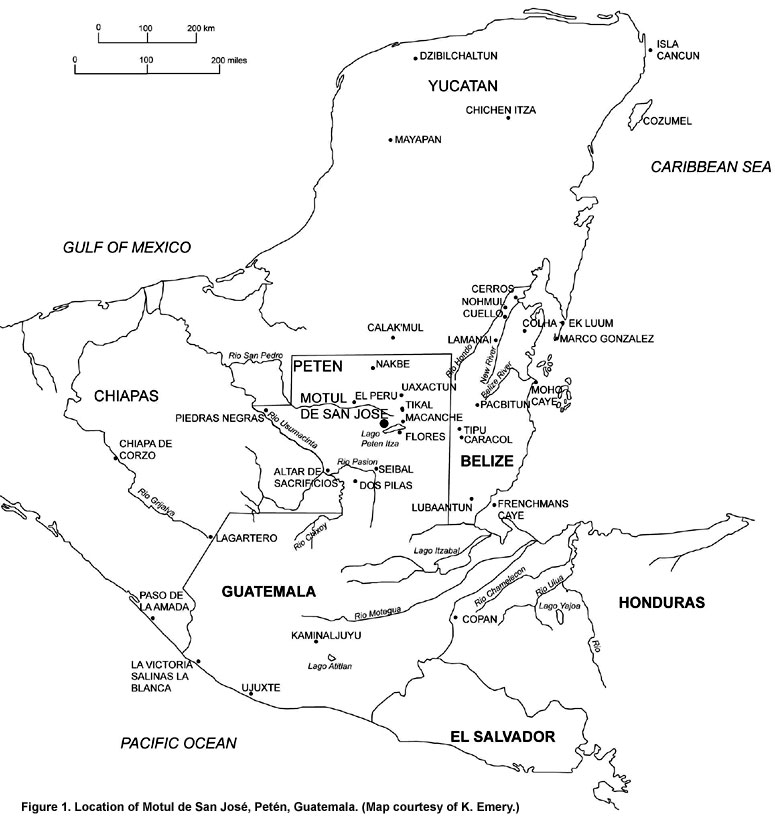
Politics and Economics: Motul de San José, Petén Introduction Perhaps the most controversial aspect of ancient Maya civilization remains the nature of Classic Maya polities, with views ranging on a continuum between decentralized small-scale city-states to regional centralized states (Adams and Smith 1981; Ball and Taschek 1991; Chase and Chase 1992, 1996; Demarest 1992, 1996; Fox et al. 1996; Gillespie 2000; Grube 2000; Houston 1993; Iannone 2002; Marcus 1993, 1998; Martin and Grube 1995, 2000; Montmollin 1989; Sharer 1993; Stuart 1993). However, as several scholars have emphasized more recently, Maya polities were dynamic, characterized by variability both across space and through time (e.g., Marcus 1993, 1998; Iannone 2002). A more valuable approach to reconstructing political structure is examining each case individually, with attention paid to the important features of their internal political organization (such as centralization, hierarchy, stratification, integration, factionalism and competition, etc.) and the human actors involved within the broader cultural and historical settings (cf. Blanton 1998). The degree of control over the economy is an important variable of political structure in all complex societies. Control over the economy provides an important power source to ancient elites, allowing them to centralize political power in their hands. Thus, in centralized polities, the relationship between political and economic power is direct and strong: the elites control all or important economic aspects, such as basic resources including agricultural land or water. In decentralized polities, political authority is based on non-economic factors, such as ideology and social relations, and the elites control little of the economy, generally only the production and/or distribution of prestige items. State economic control is therefore an important variable in the internal political dynamics of states, and deserves careful examination in each polity of the Classic Maya civilization. Begun in 1998, the Motul de San José Archaeological-Ecological Project is a long-term interdisciplinary endeavor between archaeologists, ecologists, chemists, soil specialists, and the local communities, with the central aim to explore economic state control at the small Classic Maya center of Motul de San José in northern Guatemala (Foias 1998, 1999, 2000, 2001; Foias and Castellanos 2000) (Figure 1). Motul de San José is the ideal site for this research for a number of reasons. Secondary Maya sites may have been the crucial actors in the international Classic Maya politics as they switched allegiances or seceded from the control of the primary centers, or as they specialized in economic production of particular items (e.g. Colha) (Marcus 1983; Ball and Taschek 1991). Located approximately three kilometers from the north shore of Lake Petén Itzá in Central Petén, Motul de San José (Figure 1) was one of these secondary-tier economic centers, as several lines of evidence suggest that it produced the well-known Ik-Style polychrome pottery. Named for the Emblem Glyph that appears often in the hieroglyphic texts on these vessels, the Ik style is characterized by pink slipped glyphs, historical texts, fine figural painting, frequent mention of the same two rulers, and dance or palace scenes (Reents-Budet et al. 1994). The Ik Emblem Glyph appears in the monuments of Bejucal (to the north of Motul de San José) during the Early Classic, and at Motul de San José during the Late Classic. However, the names Itsa and Kan Ek, which appear in the Motul de San José stelae, also associate the latter site with the Ik Emblem Glyph at least during the Late Classic. Chemical sourcing analyses of the Ik Style vessels by Bishop and Reents-Budet have shown that they were produced in the Motul de San José area, as they match archaeological ceramics from the site (Reents-Budet and Bishop 1989; Reents-Budet et al. 1994). Nevertheless, there is sufficient chemical variation to indicate the existence of several Ik polychrome workshops over the region to the west and northwest of Lake Petén Itzá (Reents-Budet et al. 1994). As both an economic and political center, Motul de San José has the potential to provide crucial data about the interaction of these two spheres during the Late Classic, the time period when Motul reached its apogee. Furthermore, Motul flourished and perished in the shadow of Tikal as it was under its influence at least until the early eighth century, and as such can provide clues to the relationship between the super-power and its client or vassal states. |
||
|
Text links to all pages at this site are available at the FAMSI INDEX |
||