|
FAMSI © 2004: Antonia E. Foias |
|
Politics and Economics: Motul de San José, Petén Laboratory Analysis Funded by FAMSI FAMSI funding was sought to finish the analysis of the archaeological collection excavated during the last field seasons at Motul, all of which is now stored in Salon 3, the storage facility of the Institute of Anthropology and History in Guatemala City. Of utmost importance was the analysis of the lithic material, both chert and obsidian, as the collection is significantly large (over 10,000 lithic pieces made of chert, obsidian, quartz, quartzite, and limestone). Scott Brian, graduate student at BYU, began the lithic analysis under the supervision of Dr. John Clark. After a preliminary survey of the variety of lithics found at Motul, Brian and Clark formulated a general typology for the MSJ material, defining basic categories such as flakes, biface flakes, cores, bifaces, unifaces, and so on. Because of earlier commitments to assist in a BYU field school in México, Scott Brian was able to devote only 1.5 months of the needed 3 months to finish the analysis. He plans to finish the analysis the summer of 2004. He was able to analyze approximately half of the chert lithic material. The collection has several complete and identifiable broken tools, but is dominated by flakes. The flakes and tools vary in size and shape, but were most numerous with dimensions between 3 and 6 cm (Brian 2003). Two different technologies dominated the assemblage: flake and bifacial technologies (ibid). The typology created is largely a technological one with several crosscutting elements such as description of the cortex and use wear if present (ibid). This typology will facilitate the analysis of the Motul assemblage in several ways by identifying technologies, materials, types of lithic object, and selected artifact characteristics (ibid). The analysis of the assemblage began with the satellite site of Akte, that had been investigated by Matthew Moriarty in the 2002 field season. Akte has several material and artifact types present. The next group of artifacts analyzed was MSJ 15A, which was located in the major Group D north of the Main Plaza, and represents the high elite or possible royal stratum of Motul society. As this operation was the most intensive of the excavations undertaken at Motul up to now, there were hundreds of lithic artifacts and materials. After MSJ 15A, several other smaller operations were examined with the goal of obtaining a wide spectrum of the socioeconomic strata present at the site. These operations included: MSJ 15B, MSJ 15C, MSJ 15D, MSJ 15E, MSJ 7A, MSJ 7B, MSJ 13A, MSJ 13B, MSJ 13C, MSJ 19A, MSJ 19B, MSJ 22A, MSJ 22B, MSJ 23A, MSJ 23B, MSJ 23C, MSJ 23D, MSJ 23E, MSJ 24A, MSJ 24B, MSJ 25A, MSJ 26A, MSJ 26B, MSJ 26C, MSJ 26D, MSJ 34A, MSJ 36A, MSJ 36C, MSJ 36D, MSJ 36E, MSJ 38B, MSJ 38D, MSJ 39C, MSJ 39E, MSJ 39F, MSJ 39G, MSJ 42A, MSJ 42B, MSJ 42C, MSJ 42D, MSJ 42E, MSJ 42F, MSJ 43B, MSJ 43C, MSJ 43D, MSJ 43E, MSJ 43F, MSJ 45C, and MSJ 45D (ibid). This initial analysis of approximately 50% of the MSJ lithic assemblage has yielded a number of important results. First of all, several production zones have been identified. One of these is located in operation MSJ15, although this is clearly a high-elite, if not royal residential group (ibid). Operation MSJ23 also had clear evidence for a lithic workshop (ibid). A second important discovery is that lithic manufacture at Motul involves significant thermal alteration (ibid). This process makes certain types of stone, such as chert, more malleable and therefore, more easily worked into tools. Identifying thermal alteration within an assemblage is an important characteristic of production and an indicator of knapping skill (Brian 2003). Preliminary analysis of the lithics from Buenavista, a small secondary site located some 3 km southeast of Motul, in the outskirts of the modern village Nuevo San José, showed that this is a chert extraction and first-level production center, where large chert nodules were first transformed into blanks for later further manufacture into stone tools. All the pottery excavated during the last field season sponsored by NSF and Williams College (2001) was analyzed between June and September 2003, by Foias, two Guatemalan graduate students (Jeanette Castellanos and Nancy Monterroso) and a Williams undergraduate sponsored by a Williams College Summer Research Assistantship (Jonathan Cartagena). Although the final statistical analyses remain to be done, a number of preliminary results can be put forth here. First of all, the small center of Buenavista located some 3 km south of Motul de San José, was built mostly in the Preclassic period. The two large platforms that our project investigated were only used superficially during the Late Classic and Terminal Classic periods. Although we didn’t reach the deepest layers of the larger of the two platforms explored at Buenavista, the lower deposit excavated produced pre-Mamom pottery. Comparison has to be made with the Eb material from Tikal and Xe pottery encountered in the Pasión region. Overlying this very early material from probably 1,000/900 to 600 B.C. (approximately) was a deep layer of Mamom fill, indicating that the occupation at Buenavista is quite early. Pottery analyzed from operations MSJ15, MSJ29, and small test-pitting operations in the plaza groups of the northern zone of Motul mostly date to the Late Classic period, as expected. However, one group had a substantial Early Postclassic component in the midden located behind one structure. We were also able to better define the Terminal Classic ceramic assemblage at Motul de San José through the latest excavations of Group D and the analysis of its pottery. Typical of the Terminal Classic at Motul are: rare polychromy, accompanied by an increase in the use of incised and carved-incised orange- or red-slipped serving ware; red-slipped large jars with everted rims; red-slipped jars with bulging, tall and relatively vertical necks.
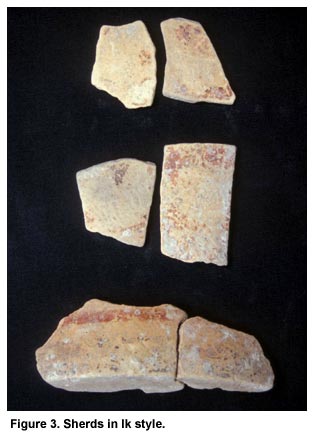
The final preliminary result of the ceramic analysis is that we encountered a number of sherds that are similar or pertain to the traditions of the Ik Polychrome School (Figure 3, shown above). These have been sampled for INAA, together with over 100 other polychrome vessels, and are under analysis by Dr. Ronald L. Bishop at the Smithsonian Institution in Washington, D.C. Analysis of Spindle Whorls and Figurines Christina Halperin, graduate student at UC-Davis, is analyzing the figurines and spindle whorls of Motul as part of her Ph.D. dissertation research on manufacturing activities at this Classic Maya center (Halperin 2003a, 2003b). Halperin (2003b) defines four types of spindle whorls at Motul: large centrally perforated sherd discs, small centrally perforated sherd discs, disc whorls, and small bead-shaped whorls. Based on extensive ethnographic, ethnohistoric and archaeological comparison, Halperin can correlate the first category of whorls with the likely production of looser and thicker thread, and the other three types of smaller whorls with finer cotton or silkier thread (ibid). Only a few examples from Motul are large enough and heavy enough to suggest the production of cordage rather than thread for textile production, but their presence indicate the variety of threads that was spun by the Maya females resident at Motul (ibid). Furthermore, spindle whorls were restricted in distribution to the prominent residential groups within Motul and its secondary centers, suggesting that spinning was restricted to these elite groups, and supporting a more centralized model for this stage of textile production (ibid). However, we need to explore the minor architectural groups of Motul and its environs in more detail before presenting our final results. Halperin (2003a) began the analysis of the Motul de San José figurines (totaling over 1,500 fragments) in 2002 with the support of Sigma Xi and the Motul de San José Archaeological Project. She finished her analysis during the summer of 2003 lab season supported by FAMSI. With the primary purpose of testing two alternative models of figurine production (dispersed, decentralized versus centralized), Halperin undertook a labor investment and skill analysis of the figurines, supplemented by the identification of refuse from the figurine production process (Halperin 2003a). Two basic techniques of figurine manufacture, modeling and molding, were identified, and based on these, Halperin established four principal types based on relative differences in labor investment and skill: (1) completely molded; (2) partially molded; (3) crudely modeled; (4) finely modeled (ibid). The first type was the most common, representing almost half of the head and almost complete figurine fragments (ibid). These completely molded figurines, though, involve the least amount of labor and skill, if we exclude the production of the mold itself (Halperin 2003a). The second type, the partially molded figurine, represents approximately 25% of the Motul collection, and consists of a molded head attached to a modeled body. The third and fourth types of figurines, representing the remaining 25% of the Motul collection, involved low levels of labor and skill (for the crudely modeled figurines) and the highest levels of labor and skill (for the finest modeled examples) (ibid). However, the finely modeled figurines were the rarest, representing 4% of the head and almost complete figurines, and only 1.5% of the body fragments (ibid). When labor investment is compared between the figurines associated with the major core groups (Groups A-E) in contrast with non-core groups, the site core exhibits slightly higher levels of labor investment in having more figurines with more applique parts (ibid). Halperin was also able to identify several loci with figurine manufacturing debris. The largest of such deposits was a midden (probably secondary, redeposited as fill to raise the level of a platform) associated with the northwest plaza of the Acropolis (the likely residence of the royal court of Motul during the Late and Terminal Classic). The high density of pottery, large quantities of ash, polychrome pottery wasters, an unfinished vase, clay lumps, and a paint miniature pot (with remains of specular hematite) suggest that this midden was associated with elaborate polychrome production, probably by attached specialists and an elite scribe. Evidence from this midden, though, also suggests that this same workshop produced high-quality figurines: the high density of figurine fragments (11% of the entire figurine collection), one figurine mold fragment, and the high frequency of finely modeled and partly molded figurines with high numbers of applique elements (comprising 50% of the figurines found in this midden) (Halperin 2003a). However, three other operations also exhibited evidence for figurine manufacture, such as waster fragments or defective fragments, or high figurine density: operation 12 and operation 29 (located in the major Groups C and E, respectively); operation 39 located in the northern zone of Motul (Halperin 2003a). The overall picture that we can reconstruct of figurine production at Motul is one of dispersed specialized production (as mold production through its rapid creation of highly standardized products) implies specialization, with some production of the most elaborate figurines under centralized control by elite groups in a domestic context. |
||
|
Text links to all pages at this site are available at the FAMSI INDEX |
||