|
FAMSI © 2005: Jennifer F. Ahlfeldt |
|
|
Structure 10L-22 Sculpture Reconstruction Project, Copán, Honduras |
||
|
Images included in this report are copyrighted and
Research Year: 2002 Table of Contents
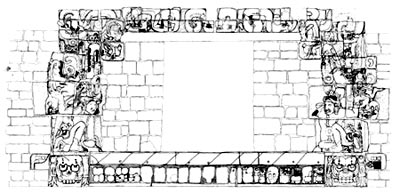
Abstract This report covers the 2002 Field Season of the Structure 22 Sculpture Reconstruction Project, an ongoing effort to reconstruct and reinterpret the eighth-century Maya building, Structure 22, at Copán, Honduras. The current reconstruction is preliminary; the first stage of a project to catalogue, conserve, restore, analyze, and digitally reconstruct the full corpus of stone façade sculpture recovered from excavations of this monument over the last century. The reinterpretation assembles recent archaeological, architectural, epigraphic, and ethnohistoric data for Copán and the Maya area to reframe the building within its eighth-century context and to consider its functions and meanings within the architectural campaign of its patron, Waxaklajun U’bah K’awil, the thirteenth ruler of Copán. As an historical inquiry, the study addresses Structure 22 as a significant event in the history of Maya architectural design. The study demonstrates the value of performance theory and semiotic and phenomenological analyses for understanding the contexts of the production and reception of the building, as well as its communicative modes. While the report below discusses only the results of the 2002 Field Season, rather than the conclusions of the entire project (Ahlfeldt 2004), it is worth summarizing the research results here briefly. Research to date indicates that Structure 22 should be considered within the dual contexts of the construction of monarchy and the experiential aesthetics of eighth-century Maya religion. Structure 22 was designed as a performance space for asserting social order during state ritual, most likely commemorations of royal accession. Erected during a period of political consolidation throughout the Maya realm, the building was designed to be competitive and conversant with the architectural campaigns of contemporaneous Maya kingdoms. The builders of Structure 22 tested the limits of sculptural skill and engineering technology at Copán while masterfully expressing the complexity and animism of Maya state religion. In commissioning this structure, Waxaklajun U’bah K’awil presented an expanded vision of divine kingship–one that emphasized his persona, situating it within historical, mythic, and cosmic frameworks. All available data confirm Miller’s hypothesis (1999) that this monument functioned as the royal throne room of Copán. It was here that the ruler was transformed into, and subsequently dwelled as, a deity. As such, Structure 22 was both a physical and conceptual extension of the royal body. Este informe cubre el trabajo hecho durante la temporada de campo llevada a cabo en 2002 para el Proyecto de Reconstrucción de la Escultura del Templo 22, un esfuerzo en curso para reconstruir y reinterpretar este edificio maya del siglo octavo en Copán, Honduras. La reconstrucción actual es preliminar; y se trata de la primera etapa de un proyecto que va a catalogar, conservar, restaurar, analizar y construir digitalmente todas las piezas de escultura de la fachada recuperadas durante las excavaciones de este monumento, efectuadas durante el siglo pasado. La reinterpretación reúne los datos arqueológicos, arquitectónicos, epigráficos y etnohistóricos recientes para Copán y el área maya, a fin de ubicar al edificio dentro de su contexto durante el siglo octavo, y para considerar sus funciones y significados dentro de la campaña arquitectónica de su patrón, Waxaklajun U’bah K’awil, decimotercer gobernante de Copán. Como investigación histórica, el estudio trata al Templo 22 como un acontecimiento significativo en la historia del diseño arquitectónico maya. El estudio demuestra el valor de "teoría de ejecución" (performance theory) y de los análisis semióticos y fenomenológicos para entender los contextos de la producción y de la recepción del edificio, así como sus modos comunicativos. Mientras que el informe que sigue discute solamente los resultados del trabajo hecho durante 2002, y no las conclusiones del proyecto entero, vale resumir brevemente aquí los resultados de esta investigación. La investigación hasta la fecha indica que el Templo 22 se debe considerar dentro de los contextos duales de la construcción de la monarquía y de la estética experimental de la religión maya del siglo octavo. El Templo 22 fue diseñado como espacio de ejecución para afirmar el orden social durante los rituales del estado, en ceremonias tales como la accesión real. Erigido durante un período de consolidación política a través del reino maya, el edificio fue diseñado para ser competitivo y versado en cuanto a las campañas arquitectónicas de los otros reinos mayas contemporáneos. Los constructores del Templo 22 pusieron a prueba los límites de la tecnología escultórica así como la ingeniería en Copán, a la vez que expresaron la complejidad y el animismo de la religión del estado maya. Al encargar esta estructura, Waxaklajun U’bah K’awil presentó una visión más amplia del reino divino – la cual acentuó su personaje, situándolo dentro de marcos históricos, míticos, y cósmicos. Todos los datos disponibles confirman la hipótesis de Miller según la cual este monumento funcionó como el salón del trono de Copán. Fue aquí que el gobernante fue transformado y subsecuentemente, tratado como un dios. Como tal, el Templo 22 era una extensión física e imaginada del cuerpo real. Click to download the report in PDF format: Structure 10L-22 Sculpture Reconstruction Project, Copán, Honduras (794 KB) The PDF files require Adobe Acrobat Reader.
Submitted 12/18/2004 by: |
||
| Return to top of page | ||
|
Text links to all pages at this site are available at the FAMSI INDEX |
||