|
FAMSI © 2004: Tricia Gabany-Guerrero |
|
Cliff Paintings of Parangaricutiro, Michoacán, México
Research Year: 2002
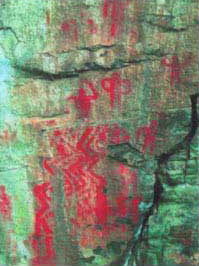
Abstract Central-West México, perhaps best known for the Late Postclassic Tarascans, has long been an anomaly in Mesoamerica. This region has frequently been omitted from classification within Mesoamerican patterns of material culture (Chadwick, 1971). Still a region of intense volcanic activity and sparsely documented biodiversity, the temperate rainforests in the highlands of Michoacán have harbored few archaeological studies in the more than 75,000 km2 once under the territorial control of the Late Postclassic Tarascans. Studies of this region have concentrated on the border with the Aztecs to the east (Pollard, 1993), the Teuchitlán complex to the northwest (Weigand, 1996), the ancient center of Zacapu (Carot, 1996) and the core Lake Pátzcuaro basin (Pollard, 1993). With the majority of studies focused on Maya (Miller, 1997; Stone, 1995) and Aztec civilizations (Smith, 2001), there is an unmistakable gap in information regarding the Tarascan civilization and its predecessors in scholarly work on Mesoamerica. This study provides documentation for iconographic and material remains for a site in the highland region of Michoacán and has the potential to provide evidence for long-term shared cultural and material systems with Mesoamerica. Although several early colonial codices exist from the Tarascan region, PreColumbian codices and Mesoamerican iconography in paintings are unknown. This research project focused on a highland cliff painting site in the foothills of the Tancítaro volcanic range, near the volcano Parícutin (eruption, 1943). An interdisciplinary team of researchers studied a series of layered cliff paintings and accompanying artifacts located in a caldera in this highland volcanic region. Located at approximately 2500 m asl., the paintings found on eight of the inner cliffs of the caldera present examples of Mesoamerican iconography. Mesoamerican motifs (including personages and deities) predominate on the principal panel. In addition, archaic motifs (hunters/dancers and animals) are distributed throughout the cliff walls. Lithics, a small number of ceramics, and human and animal remains, were excavated from test pits beneath the cliff paintings. The discovery of a burial in a test pit below one of the cliff paintings suggests that this site was of ritual importance. The stratigraphy of the site indicates two principal periods of ritual use: (1) a deer antler tool, on a cliff shelf buried beside paintings demonstrating Classic Period iconography, was dated to the Classic Period (calibrated BP 1610 to 1530); and (2) three bone collagen samples from long bones of human remains returned Late Archaic Period dates (calibrated BP 4520-4290, 4510-4480, and 4440-4260). Dating of human remains from this site would place it as the oldest known burial from Central-West México, predating El Opeño burials by approximately one thousand years (Noguera, 1931; Oliveros, 1975). Arnauld, Metcalfe, Petrequin (1992) have discussed climatic changes resulting in drier climates for the Late Holocene in lowlands of Zacapu, Michoacán. Their results coincide with studies documenting similar conditions during the same period in the Central Basin of México (Buckler, Pearsall, Holtsford, 1997). The results to-date from the Alberca research project suggest a hypothesis that high-altitude environments in Michoacán, such as calderas rich in aquatic resources, could have served as critical habitats for humans and wildlife during the Late Archaic, when dry environmental conditions persisted in the Western Hemisphere. Thus, the sparse data for the Late Archaic in Central-West México may be due to the lack of research in appropriate ecological zones. Desde hace mucho tiempo, el centro-oeste de México, tal vez mejor conocido por los tarascos del Posclásico Tardío que lo habitaron, ha sido considerado una anomalía de Mesoamérica. A esta región y con frecuencia, se la ha omitido de las clasificaciones dentro de los modelos mesoamericanos de cultura material (Chadwick, 1971). Aún siendo una región de intensa actividad volcánica y de una biodiversidad escasamente documentada, los bosques lluviosos templados de las tierras altas de Michoacán han sido objeto de pocos estudios arqueológicos en los más de 75.000 km2 que una vez estuvieron bajo el control de los tarascos del Posclásico Tardío. Los estudios de esta región se han concentrado en la frontera con los aztecas, hacia el este (Pollard, 1993), en el complejo Teuchitlán hacia el noroeste (Weigand, 1996), en el antiguo centro de Zacapu (Carot, 1996), y en la porción central de la cuenca del lago Pátzcuaro (Pollard, 1993). Como la mayoría de los estudios tuvieron como principal foco de interés las civilizaciones maya (Miller, 1997; Stone, 1995) y azteca (Smith, 2001), hay una brecha inconfundible en lo que tiene que ver con la información referida a la civilización tarasca y a sus predecesoras en los trabajos académicos sobre Mesoamérica. El presente estudio aporta documentación sobre restos iconográficos y materiales de un sitio ubicado en la región de las tierras altas de Michoacán, y cuenta con el potencial de proporcionar evidencias de sistemas culturales y materiales de largo plazo compartidos con Mesoamérica. Si bien existen varios códices de principios de la colonia sobre la región tarasca, no se conocen códices precolombinos e iconografía mesoamericana en pinturas. Este proyecto de investigación se ha concentrado en un sitio de pinturas en un risco de las tierras altas al pie de la cadena volcánica de Tancítaro, cercana al volcán Parícutin (que hizo erupción en 1943). Un grupo interdisciplinario de investigadores estudió una serie de distintas capas de pinturas hechas sobre riscos junto con los artefactos que las acompañaban, hallados en una caldera en esta región volcánica de las tierras altas. Ubicada aproximadamente a 2500 m sobre el nivel del mar, las pinturas halladas en ocho de los farallones interiores de la caldera presentan ejemplos de iconografía mesoamericana. Los motivos mesoamericanos (entre ellos los personajes y las deidades) predominan en el panel principal. Además, hay motivos arcaicos (cazadores/danzantes y animales) distribuidos por todos las paredes del acantilado. De pozos excavados al pie de las pinturas hechas en estos farallones, se recuperaron objetos líticos, una pequeña cantidad de cerámicas, y restos humanos y de animales. El descubrimiento de un entierro en un pozo de prueba debajo de una de las pinturas del risco, sugiere que este sitio era de importancia ritual. La estratigrafía del sitio marca dos períodos principales de uso ritual: (1) un instrumento hecho con la cornamenta de un ciervo, hallada en una saliente del risco y enterrado junto a las pinturas, lo cual demuestra una iconografía del período Clásico, fue fechado para el período Clásico (1610 a 1530 AP, calibrada); y (2) tres muestras de colágeno óseo de huesos largos de restos humanos arrojaron fechamientos del período Arcaico Tardío (4520 al 4290, 4510 al 4480, y 4440 al 4260 AP, calibrados). El fechamiento de los restos humanos de este sitio lo ubicaría como el entierro más antiguo que se conozca del centro-oeste de México, anterior a los entierros de El Opeño en aproximadamente mil años (Noguera, 1931; Oliveros, 1975). Arnauld, Metcalfe, Petrequin (1992) se han referido a los cambios climáticos que resultaron en climas más secos durante el Holoceno Tardío en las tierras bajas de Zacapu, Michoacán. Los resultados de estos investigadores coinciden con los estudios que documentan condiciones similares durante el mismo período en la Cuenca Central de México (Buckler, Pearsall, Holtsford, 1997). Los resultados del proyecto de investigación en La Alberca hasta este momento sugieren una hipótesis según la cual los entornos de altitudes pronunciadas de Michoacán, tales como las calderas, ricas en recursos acuáticos, podían haber servido como habitats críticos para los seres humanos y la vida silvestre durante al Arcaico Tardío, cuando las condiciones ambientales de sequía persistieron en el Hemisferio Occidental. De este modo, la escasez de datos para el Arcaico Tardío en el centro-oeste de México puede haberse debido a la falta de investigaciones realizadas en las zonas ecológicas apropiadas. Click to download the report in PDF format: Cliff Paintings of Parangaricutiro, Michoacán, México (2.10 MB) The PDF files require Adobe Acrobat Reader.
Submitted 10/09/2003 by: |
||
|
Text links to all pages at this site are available at the FAMSI INDEX |
||