|
FAMSI © 2004: Adolfo Iván Batún Alpuche |
|
Maya Settlement Patterns and Land Use in Buena Vista, Cozumel, México |
||
|
Research Year: 2003 Table of Contents
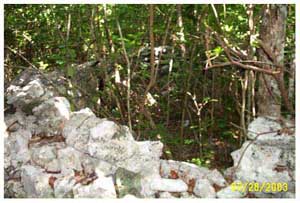
Abstract The Buena Vista Archaeological Project is a study of postclassic Maya settlement patterns and land use on the island of Cozumel, México. Field work carried out in the site during the months of June–August 2003 was sponsored by the Foundation for the Advancement of Mesoamerican Studies, Inc., (FAMSI). Previous archaeological research in Buena Vista had focused in a central area of seven hectares and reported the existence of an extensive wall system and platforms at the site which was interpreted as a storage center for exchange and resupply transactions. In this interpretation, the platforms supported perishable structures used to store trade commodities, and the wall system was built to protect these trade goods from possible pirate attacks (Sabloff and Rathje 1975, Freidel and Sabloff 1984). However, the nature and extension of the wall system around the central area had not been investigated in detail. The research objectives of this project were to analyze the Buena Vista settlement pattern following a settlement ecology model (Stone 1996, Killion 1992), which seeks to understand the relationship between population and agricultural practices in an ecological setting. The project followed a program of surface survey and mapping of the wall system, related structures, and natural features located in an area of 4 km2 around the center of the site. Preliminary results of this study presented in this report show how the Buena Vista settlement pattern seems to be that of an agrarian settlement totally adapted to its ecological setting and not a trade/storage center as previously thought. El Proyecto Buena Vista es un estudio del patrón de asentamiento del Posclásico maya y del uso del suelo en la isla de Cozumel, México. El trabajo de campo llevado a cabo en el sitio de junio a agosto del 2003, fue patrocinado por la Fundación para el Avance de los Estudios Mesoamericanos, Inc. (FAMSI). La investigación arqueológica previa en Buena Vista estuvo concentrada en un área central de siete hectáreas, en las que se observó la presencia en el sitio de un extenso sistema de albarradas y plataformas, que fue interpretado como un centro de almacenamiento para actividades de intercambio y reabastecimiento. Según ésta interpretación, las plataformas servían de base a estructuras hechas con material perecedero que se utilizaban para almacenar bienes de intercambio, y el sistema de albarradas fue construido para proteger estos bienes contra posibles ataques piratas (Sabloff y Rathje 1975, Freidel y Sabloff 1984). Sin embargo, la naturaleza y extensión del sistema de albarradas no fueron investigadas en detalle. El objetivo de investigación en este proyecto fue analizar el patrón de asentamiento en Buena Vista, siguiendo un modelo de ecología de asentamiento (Stone 1996, Killion 1992), a fin de llegar a entender la relación entre población y prácticas agrícolas en su entorno ecológico. El proyecto siguió un programa de prospección de superficie y mapeo del sistema de albarradas, de las estructuras asociadas y de las características naturales ubicadas en un área de 4 km2 alrededor del centro del sitio. Los resultados preliminares de este estudio presentados en el el presente informe ponen en evidencia que el patrón de asentamiento de Buena Vista se asemeja al de un asentamiento agrícola totalmente adaptado a su entorno ecológico, y no al de un centro de comercio/almacenamiento, como se pensó anteriormente. Click to download the report in PDF format: Maya Settlement Patterns and Land Use in Buena Vista, Cozumel, Mexico (1.31 MB) The PDF files require Adobe Acrobat Reader.
Submitted 03/05/2004 by: |
||
| Return to top of page | ||
|
Text links to all pages at this site are available at the FAMSI INDEX |
||