|
FAMSI © 2004: Sarah B. Barber |
|
Proyecto Río Verde, 2003: Report on Excavations at Yugüe |
||
|
Research Year: 2003 Table of Contents
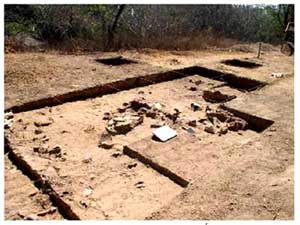
Abstract This report summarizes the results of excavations undertaken at the site of Yugüe, in the lower Río Verde valley of Oaxaca, México. The Yugüe excavations were undertaken from February to April of 2003 as part of the Proyecto Río Verde 2003 (PRV03). The PRV03 was designed as a study of early state organization on the Pacific coast of Oaxaca, focusing on elite activities in the lower Río Verde valley’s first regional polity. A second goal of the PRV03 was to obtain as much archaeological information as possible from the threatened site of Yugüe, where ongoing construction is causing irrevocable damage to a Terminal Formative Period (150 B.C.–A.D. 250) archaeological site. The Yugüe excavations were very successful, providing the first primary deposits related to Terminal Formative elite public activities such as burial, feasting, and other rituals. An addendum is included with this report summarizing the results of conservation efforts undertaken to conserve and restore a late Terminal Formative Period (A.D. 100–250) incised bone flute from the site of Yugüe. The object was discovered during the Proyecto Río Verde 2003. At the time of its discovery, the flute was in extremely fragile condition due to compaction, seasonal changes in humidity, and bioturbation in the form of root and insect activity. Mireya Olvera Sánchez consolidated, reconstructed, and restored the object. It is now in the collection of the Centro Cultural Santo Domingo, Oaxaca City, México. Este informe presenta los resultados de excavaciones arqueológicas en el sitio de Yugüe, ubicado en el valle inferior del Río Verde. Las excavaciones tuvieron lugar entre febrero y abril del año 2003, y formaron parte del Proyecto Río Verde 2003 (PRV03). El PRV03 se diseñó como un estudio de la organización estatal del período Formativo Terminal (150 a.C.–250 d.C.) en la Costa Chica de Oaxaca, México. El objetivo principal era el de obtener datos sobre las actividades de la élite en el primer estado regional del valle inferior del Río Verde. El segundo objetivo del PRV03 fue el de emprender excavaciones de rescate en el sitio, que corre peligro a causa de una reocupación moderna del sitio. La construcción moderna continúa causado daños irreparables en este sitio del período Formativo Terminal. Las excavaciones tuvieron éxito, puesto que llegaron a proporcionar los contextos primarios correspondientes a las actividades públicas de la élite durante el período Formativo Terminal, incluyendo entierros, fiestas y rituales. Este informe incluye un apéndice que resume los resultados de la restauración y conservación de una flauta de hueso del período Formativo Terminal (100–250 d.C.), proveniente del sitio de Yugüe. El objeto se descubrió durante las excavaciones del Proyecto Río Verde 2003. Cuando fue descubierta, esta flauta denotaba gran fragilidad debido a la compactación, a los cambios de humedad estacionales, y a las bioperturbaciones causadas por las raíces y la actividad de los insectos. La Lic. Mireya Olvera Sánchez se ocupó de consolidar, reconstruir y restaurar el objeto. La flauta está en la colección del Centro Cultural Santo Domingo, Oaxaca de Juárez, México. Click to download the report in PDF format: Proyecto Río Verde, 2003: Report on Excavations at Yugüe (698 KB) The PDF files require Adobe Acrobat Reader.
Submitted 03/08/2004 by: |
||
| Return to top of page | ||
|
Text links to all pages at this site are available at the FAMSI INDEX |
||