|
FAMSI © 2005: Andrew R. Wyatt |
|
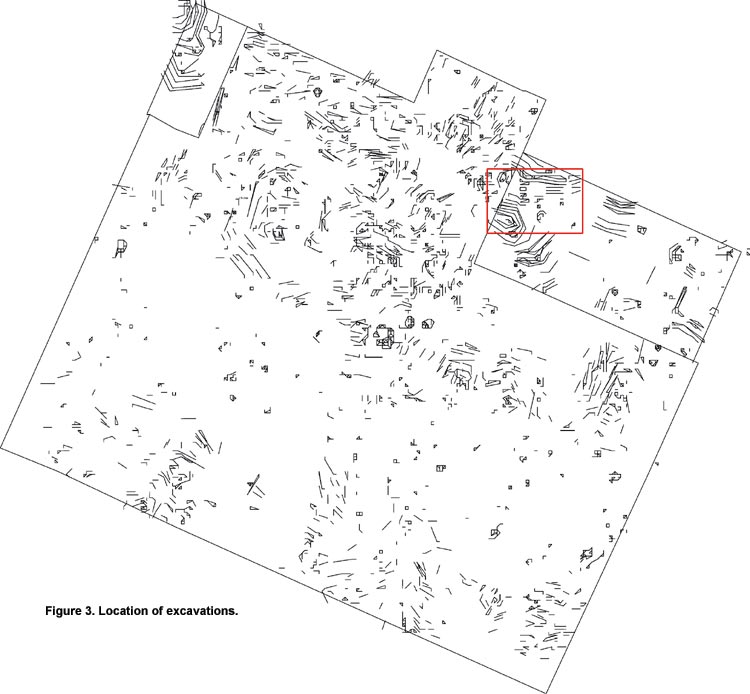
Excavations on Agricultural Terraces: Results of the 2004 Field Season at Chan, Belize Results of 2004 Excavations: Overview Excavations funded by a grant from the Foundation for the Advancement of Mesoamerican Studies, Inc., (FAMSI) in 2004 were undertaken in an area of particularly dense terracing to the north of the site center (Figure 3). These excavations concentrated on the exposure of significant areas of terrace bed surfaces and terrace walls as well as revealing the function and construction sequence of an adjacent household and associated domestic middens located on the terraced hillside (Wyatt 2004). Excavations illustrated a contiguous construction of terrace and structure walls, thereby making it possible to propose dates for terrace construction based on the construction history of the associated household structure. Also, careful excavation of terrace wall fill provided dates for the construction of terraces away from the structure. Preliminary ceramic analysis indicates that both the structure and the terraces here date to the Early Classic/Late Terminal Formative period, based upon the presence of waxy slips and identifiable vessel forms (LeCount personal communication). Our methodology of utilizing extensive areal excavations on terrace beds, terrace walls, and the structure located on the terraced hillside allowed us to document a number of significant features that would have otherwise gone unnoticed. In these excavations we were able to identify: 1) buried terrace bed surfaces, providing a context for paleoethnobotanical findings; 2) multiple terrace construction phases, including an early terrace wall buried within the terrace bed; 3) the articulation of terrace walls and the structure, demonstrating that they could be stratigraphically linked, and; 4) a complex range of water management features associated with the terraces and the structure. These findings demonstrate the utility of excavating large areas in agricultural areas. The results of the 2004 season suggest several basic conclusions. First of all, the farmers in this area had been modifying and cultivating the landscape for a long period of time. These were not newcomers expanding into the hinterlands because of a Late Classic population explosion, but people who had been cultivating the hillslopes at Chan for many generations. Secondly, the small-scale water management features hint at a complexity of agricultural practices suggested only by large-scale features at sites such as Tikal (Scarborough 2004). The farmers at Chan thus seem more akin to the agricultural smallholders discussed by Netting, who have devoted labor towards the creation of landesque capital, in contrast to shifting cultivators or large-scale food monocroppers (1993:2-3). |
||
|
Text links to all pages at this site are available at the FAMSI INDEX |
||