|
FAMSI © 2002: Heather S. Orr |
|
Danzantes of Building L at Monte Albán This report was written and submitted in 1994 and, barring some minor revisions, reflects data, research, and publications to that date.
Research Year: 1994 Table of Contents
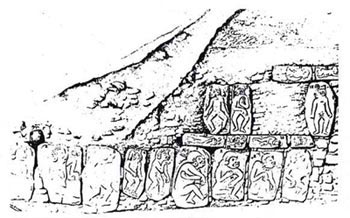
Abstract The supporting grant provided by FAMSI in January of 1994 enabled me to continue my studies at the important PreColumbian city of Monte Albán until the end of March, 1994. I had worked in a voluntary capacity at Monte Albán since September 1993, under the direction of Marcus Winter, for the Proyecto Especial Monte Albán. My FAMSI project was conceived due to the imminent need to record excavations undertaken in the North Tunnel of Building L, to determine the construction sequence of this structure, and to document the poorly known area north of Building L (Area L-North). The Danzantes wall of Building L at Monte Albán is perhaps the sole structure at this site with its sculptural program in primary context. The Danzantes sculptures are pecked figures with some hieroglyphs carved on the surface of removable stone slabs or blocks which faced rubble core structures as revetment walls. Some slabs have been recarved with two or more Danzantes. The Danzantes figures are considered by several researchers to represent sacrificed individuals, probably captives of war (refer to discussion in Orr 1997). This type of carving dates to the Late Formative period and seems to appear with the foundation of Monte Albán. The profusion of these carvings (more than 300 known) indicates an emphasis on this form of power during the initial development of the mountain-top capital city. Clearly, an understanding of how these carvings functioned in the architectural-sculptural programming of early Monte Albán is critical to discussions of elite political strategy and the Late Formative political configuration of the city and other valley centers with which it interacted. The Danzantes wall is the sole location in which the Danzante carvings are found in situ. The wall has been built over and modified. The original structure which it faced has been buried and truncated by later construction activities. Earlier excavations in the area yielded important data, however, the explorations of the Proyecto Especial provided a unique opportunity to determine the construction sequences of the area and to reconstruct the type of structure decorated by Danzantes carvings and how such structures functioned in ritual. In addition, the area between Building L and System IV (Area L-North, Figure 4), which bore a significant relationship to the Danzantes building in its early stages of construction, was cleared, consolidated, tested, and recorded by myself and supervising archaeologist Miroslava Zúñiga Vásquez. La beca de apoyo otorgada por FAMSI en enero de 1994 me permitió continuar con mis estudios en la importante ciudad precolombina de Monte Albán hasta fines de marzo de ese mismo año. Había estado trabajando como voluntaria en ese sitio desde septiembre de 1993, bajo la dirección de Marcus Winter, para el Proyecto Especial Monte Albán. Mi proyecto para FAMSI fue concebido debido a la inminente necesidad de registrar las excavaciones emprendidas en el Túnel Norte del Edificio L, para determinar la secuencia constructiva de esta estructura, y para documentar el área poco conocida al norte del Edificio L (Área L-Norte). El muro de los Danzantes del Edificio L de Monte Albán es tal vez sea la única estructura del sitio que tiene su programa escultórico en su contexto primario. Las esculturas de los Danzantes son figuras picadas en la piedra con algunos jeroglifos grabados en la superficie de losas de piedra removibles, o en bloques que miraban hacia un núcleo estructural de ripio como muros de revestimiento. Algunas losas habían sido re-esculpidas con dos o más Danzantes. Varios expertos son de la opinión que las figuras de los Danzantes representan individuos sacrificados, probablemente cautivos de guerra (véase la discusión en Orr 1997). Este tipo de esculturas está fechado para el período Formativo Tardío y parece hacer su aparición con la fundación de Monte Albán. La profusión de estas tallas (se conocen más de 300), muestra un énfasis en esta forma de poder durante el desarrollo inicial de esta ciudad capital asentada en lo alto de la montaña. Está claro que llegar a entender cómo funcionaban estas tallas en el programa arquitectónico-escultural de la primera Monte Albán, constituye un punto crítico para las discusiones sobre las estrategias políticas de la élite y la configuración política de la ciudad en el Formativo Tardío, y de otros centros del valle con los cuales interactuaba. El muro de los Danzantes es la única localización en la cual los grabados de los Danzantes se encuentran en situ. El muro ha sido reconstruído y modificado. La estructura original que tenía enfrente ha sido enterrada y truncada por actividades constructivas posteriores. Las excavaciones practicadas en el área con anterioridad han arrojado datos de importancia, y sin embargo, las exploraciones del Proyecto Especial representaron una oportunidad única para determinar las secuencias constructivas del área y para reconstruir el tipo de estructuras decoradas con tallas de Danzantes y el papel que jugaban dichas estructuras en los rituales. Además, el área comprendida entre el Edificio L y el Sistema IV (Área L-Norte, Figura 4), que tenía una relación importante con el edificio de los Danzantes en sus primeras etapas de construcción, fue despejada, consolidada, excavada, y registrada por mí y por la arqueóloga supervisora Miroslava Zúñiga Vázquez. Click to download the report in PDF format: Danzantes of Building L at Monte Albán (595 KB) The PDF files require Adobe Acrobat Reader.
Submitted 08/01/1994 by: |
||
| Return to top of page | ||
|
Text links to all pages at this site are available at the FAMSI INDEX |
||