|
FAMSI © 1999: Frank Kent Reilly, III |
|
Olmec-style Iconography
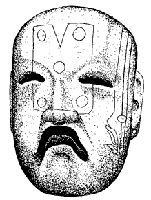
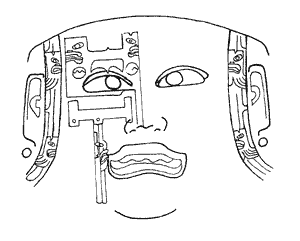
Research Year: 1995 The Olmec Art Style Three thousand years ago, Mesoamerica experienced the development of a geographically dispersed art style whose origins can be traced to the Olmec archaeological culture. Olmec art visualized a shamanic belief system that also functioned as the ideological foundations for political power. The symbol system, which is central to any discussion of Olmec art, was expressed as incised images on a range of objects and mediums. Olmec art is thematically conservative, primarily restricted to visually describing cosmology, the inhabitants of the supernatural Otherworld, ritual activity, and political power derived from supernatural access. Many of the objects created in the Olmec style functioned as empowered accoutrements in the shamanic rituals through which political power was sanctified by supernatural power. Much of the monumental art executed in the Olmec style was created as a permanent record of this shamanic ritual activity. The iconography and symbolism that are central to any discussion of the Olmec style were to be inherited by all later Mesoamerican cultures. The ideological messages conveyed by this highly developed Olmec symbol system continued to function as the underlying matrix for both political power and religion throughout the lengthy history of Mesoamerica. My recent viewing of several objects in private collections has served to underscore the need for new and accurate renderings of the secondary incised images, which are carried by such objects. For example, a close observation of a jade mask from the Olmec heartland site of Arroyo Pesquero formerly in the Dyker collection (Figure 1) reveals that the published drawings of this object are inaccurate in at least one critical detail. That missing detail was a thumb carried on the two hand-paw-wing motifs incised on the left side of the mask.
Click to download the report in PDF format: Olmec-style Iconography (537 KB) The PDF files require Adobe Acrobat Reader.
Submitted 01/01/1997 by: |
||
| Return to top of page | ||
|
Text links to all pages at this site are available at the FAMSI INDEX |
||