A Facsimile Edition of Mapa de Oztoticpac
Vea este informe en Español.
Printable version

Click on image to enlarge
Research Year: 1996
Culture: Aztec
Chronology: Post Classic
Location: Northease México, Near Texcoco
Site: Unknown
Facsimile Editions
Fortunately there is now a serious movement to publish Mesoamerican pictographic documents and it promises to continue through the 1990s. Working directly with originals has become more and more difficult. Codices are scattered throughout several countries; they are fragile and many are in an advanced state of deterioration. Institutions have imposed ever greater restrictions to check their holdings and, in spite of technical advances in preservation, the loss of data is irremediable since, for example, colors fade and change over time. For those reasons, publishing facsimiles is the only way to create a solid corpus of new and efficient instruments to work with.
The Mapa de Oztoticpac
Mapa de Oztoticpac is one of the earliest Indian pictorial documents painted after the Spanish conquest of Central México. It is a first class codex which deserves to be adequately reproduced. The Mapa comes not from the town of San Nicolás Oztoticpac, situated in the municipality of Otumba, in the northeast section of the State of México; rather it refers principally to a still unidentified place very close to the city of Texcoco, east of México City. It measures 96 by 105.6 centimeters and was painted on amatl paper. It is well preserved though it does show evidence of having been folded in four parts.
We are not speaking here of dramatic and colorful scenes. It is, rather, a complex document which is pragmatic in character, without spectacular illustrations such as those we find in Precolumbian and early Colonial religious codices. But its content is of great interest. Besides cadastral information, it contains different types of data we will mention further on.
We do not know how or when the Library of Congress (Washington, D.C.) acquired the Mapa. By 1905 the Mapa is reported in the possession of the Library. Today it is kept in the Geography and Map Division, with the number 247. The only published photographs of the document are black and white and they do not do justice to the images in the original. These were drawn with great precision and practiced the same integration of native and European elements as are found in other pictographs from Acolhuacan (the area east of México City, whose political center was Texcoco). A color photograph is available, but it is so small it cant be used for purposes of research. 1
The origin of the document can be directly linked to the fate of Don Carlos Ometochtli Chichimecatecuhtli or Chichimecatecólotl. Don Carlos was a member of the Acolhua nobility which had ruled the area since the 15th century. He was the son of Nezahualpilli Acamapichtli and the grandson of the celebrated Nezahualcóyotl Acolmiztli.
At that time the bishop Juan de Zumárraga (1476-1548), a Franciscan friar, had been appointed Apostolic Inquisitor Against Depraved Heresy and Apostasy in the Capital of México and throughout the Bishopric. In a strange and extreme case of unnecessary cruelty toward the pipiltin (Indian nobility) of the recently conquered communities, Zumárraga, in 1539, ordered that Don Carlos be captured and tried. He was accused, among other things, of idolatry and concubinage along with practicing pagan sacrifices. The same year, he was condemned to death by fire and all of his worldly goods were confiscated. 2
This harsh punishment against a close member of the family of the great Nezahualpilli provoked a great scandal among the indigenous noblemen. It also generated a goodly number of problems, one of which was the subsequent protection of the patrimony of the Acolhua nobility (cultivated fields and orchards of transplanted European fruit trees) which had been in the hands of Don Carlos.
From these circumstances, it is inferred that the Mapa de Oztoticpac was prepared to defend the properties of the nobility of Texcoco. It was probably ordered by the tlatoani (native ruler) Don Antonio Pimentel Tlahuilotzin, who governed Texcoco between 1540 and 1546. 3 The texts which accompany the pictography mention the estate of Don Carlos and that of his brother, Fernando Cortés Ixtlixóchitl.
As it was previously stated, this is a fairly early document, prepared between 1540 and 1541. It describes, among other important affairs, how the recently conquered Indian nobility was using mechanisms of litigation and the presentation of legal evidence within the Spanish system.
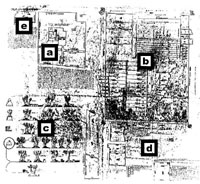
Let us take a look at the content of the pictography. Approximately three fourths of the document presents registered holdings through the use of a complex traditional measuring system (Figure 1a, b and d). The plots of land and the buildings that are illustrated were located at one time in barrios (wards) not far from Tezcoco. Also, because the Mapa is the oldest known registered example of a legal suit related to agriculture, it gives us valuable information about the grafting of fruit trees as practiced in the 1540s, in the heart of the Acolhuacan.
The last fourth of the manuscript, located in the lower left (Figure 1c), illustrates an interesting series of 20 tree trunks which are grafted with branches of European fruit trees. We recognize pomegranate, quince, apple, pear and peach along with vineyards. On one side of the scene four place glyphs appear. They correspond to Texcotzinco, Cuauhyácac, Tlaxomolco, and Oztoticpac.
The reason this information was included seems to derive from a suit brought in 1540 on behalf of Pedro de Vergara who asks that the grafted orchards, at one time in the possession of Don Carlos Ometochtli, revert to him. It seems that Vergara had not concluded a transaction with Don Carlos involving the grafting of the trees. The grafted trees had been confiscated by the Inquisition and were sold, along with the land plots, to Alonso de Contreras.
All cadastral information is accompanied by texts varying in length. They are written in Spanish and Náhuatl, and in addition to Oztoticpac, they mention Texcoco and Tollantzinco (in the State of Hidalgo). Seventy-five autonomous sections of land appear in the upper right of this section. These parcels of land appear to have been donated to Don Carlos Ometochtli by Fernando Cortes Ixtlixóchitl.
In the section corresponding to the lower right (Figure 1d) more plots of land are represented. They have not yet been identified but may refer to Octipac, Tototzinco, Apocopan, Hueiatl and Atlxocopan. Mention is made of individuals such as Huehuexoxol, grandfather of the mother of Don Carlos Ometochtli, and the quantity of blankets given in payment for the lands.
The upper left section is extremely interesting (Figure 1a). The drawings of lands and the diagram of various buildings located inside an enclosure are of a startling similarity to Fragment VI of the Humboldt Collection (Figure 2). This interesting pictographic fragment dates from between 1545 and 1546. 4 It consists of a drawing on a piece of amatl paper and measures 20 by 21 centimeters. It is now owned by the German State Library of Berlin.

Click on image to enlarge
It presents the same building complex seen in the Mapa de Oztoticpac along with an interesting group of seven individuals. Six of them are Spanish officials and the seventh, an Indian governor, is probably Don Antonio Pimentel Tlahuilotzin. In contrast, the Mapa de Oztoticpac contains long glosses that dont appear in Fragment VI. Combining the information to be found in both documents, we can infer that they speak about the patrimony or estate belonging to the lineage of the Acolhua pipiltin who inhabited the palaces (tecpancalli) built by Quinatzin in the 14th century and which were utilized by Don Carlos Ometochtli and his wife Doña Maria beginning in 1532.
Finally, as though it were an autonomous subsection, a parcel of land was drawn in the upper left corner (Figure 1e). The actual parcel was located in Tollantzinco (State of Hidalgo), and the gloss added in Spanish reads "this is because it is not certain that Ixtlixochitl gave this to Don Carlos who claimed ownership".
Apart from the cadastral sections of the Mapa de Oztoticpac, the rest of the manuscript evidences a strong European influence: the drawings are more oriented toward the perceptual than the conceptual. The European presence is notable when we regard the place glyphs. Take, for example, the way glyphs for cave (óztotl) and skein (icpatl) were combined to form a word for the place name in Codex Mendoza (Figure 3) and its counterpart in the Mapa de Oztoticpac (Figure 1c, circle). 5

The various representations of lands were not drawn using the same scale, but they express a model that can serve as an adequate reference for practical uses. This is in contrast to the ritual or figurative spaces we find in some of the Precolumbian Mixtec documents from Oaxaca or the still elusive Borgia group. The Mapa does not deal with extensive territories as the ones shown in Codex Xólotl, for instance. The Mapa comes closer in concept to the so called Códices indigenas de algunos pueblos del Marquesado del Valle de Oaxaca
, the Fragment VIII of the Humboldt Collection, the Codex Santa María Asunción, the Codex Vergara, the Códice de las posesiones de don Andrés, or some sections of the Codex Tepetlaoztoc or Kingsborough. 6
The space represented in Fragment VI of the Humboldt Collection is considerably reduced and, in general, is closer to the traditional indigenous style particularly in the representation of human figures and onomastic and place glyphs. On the other hand, in both documents we find an architectonic representation which is a strange mix, combining elevations and floor plans which utilize native and European elements. 7
Although the glyphic representation is relatively simple, interpreting the land measuring system still presents a challenge. It seems to be an old tradition of measuring agricultural plots which continued to be used for some time after the conquest. Needless to say, it was vitally important for the indigenous population to determine exactly the extension of their patrimonial and community lands. Within the Precolumbian system of land tenure, private ownership did not exist. Don Carlos Ometochtli enjoyed the income from certain lands. They were his to work. But he did not "own" them. They were part of a patrimony belonging in common to the Acolhuacan píllotl (Indian noble class). When Don Carlos Ometochtli was executed, it was incumbent upon the Acolhuacan nobility to prove ownership. These two documents attempt to define the origin and location of certain property "used" by Don Carlos.
The problem of deciphering the survey system represented in traditional Náhuatl manuscripts has been studied by various scholars. 8 However, we have yet to discover the formulas for converting the traditional system of land measurement into the modern metric system. We are still hoping to find the key of the Native system which could be characterized as "true, easily sustained, austere in its content, slightly redundant, eloquent and accessible to everyone". 9
What Herbert R. Harvey detected in the Mapa de Oztoticpac is still a mystery which he describes in the following way:
What is especially troublesome in deciphering the Oztoticpac Lands Map was the fact that two different standard measures were used, the 2.5 m. quahuiti and a 1.77 m.(?) cemmatl, without any special glyphic warning of the shift and without any modification in notation. This should serve as a caution in deciphering land documents elsewhere. Eventually, it should be possible to clarify the reasons for preference of one or another or else the rules governing the use of one or the other. 10
Accomplishments
We conclude this report by mentioning the matters which were particularly enriched after checking the original pictorial manuscript in Washington, D.C. and consulting the Archivo General de la Nación in México City:
Forms and colors. I gathered a good amount of data on these matters. Cline and Harvey (see "Previous works on the Mapa de Oztoticpac") had a secondary interest in describing forms and colors.
Place names. Important iconographic details were clarified. This will give me the opportunity to look for the right geographical locations mentioned in the Mapa.
Glosses. The texts in Spanish and Náhuatl were carefully reconstructed and compared with previous translations.
Don Carlos Ometochtlis trial (June-November 1539). Consulting Archivo General de la Nación, Ramo Inquisición (volume II, exp. 10, folios 242-346) provided me with further information on the trial of ill-fated Don Carlos Ometochtli and its consequences in the Acolhuacan and elsewhere. Although the trial deals basically with his religious misdeeds, there are important clues to reconstruct his biography and economic activities in both Indian and Spanish communities.
Native measuring systems. Despite efforts made during the past months, this is the least known topic to me (and unfortunately is a crucial one). I have already examined the works of modern scholars and noticed their severe disagreements in dealing with native vis-à-vis European-Spanish land measuring system -- or systems? I think the problem will not be solved until all available examples be published and thoroughly described and studied. Then we will be able, for the first time, to compare and contrast their cadastral information.
Photos and copies of related material. The days I spent in the Library of Congress gave me the possibility to acquire good photographic material of the Mapa and collect copies of related materials in the Geography and Map as well as the Manuscript Divisions.
As it was stated in the original proposal, El Colegio Mexiquense AC. (The Research Center in Humanities and Social Sciences for the State of México), with the support of the Library of Congress in Washington, D.C., plans to publish a facsimile edition of Mapa de Oztoticpac and Fragment VI of the Humboldt Collection, along with an introductory note containing further information above mentioned.
Looking further ahead, the preservation and diffusion of other pictorial documents originating in areas close to México City is an urgent task. We are talking here about preserving the identity of small ancient population centers or of their wards. These settlements are being swallowed up by a sometimes violent urban development and will soon disappear. The Acolhua region was particularly important since late Preclassic times (ca. 500 A.D.-200 D.C.) Though they played only a minor role in early Colonial history, the documents which are their patrimony should be preserved.
Endnotes
1 See John R. Hébert (editor), 1492. An Ongoing Voyage, Washington, The Library of Congress, 1992, p. 139.
2 This decision is in direct contrast to the generally benevolent administration of Zumárraga. He was harshly criticized by the Spanish crown, so much that Indians were removed from the jurisdiction of the Inquisition. The prohibition later formed part of the Leyes de Indias.
3 Cline, "The Oztoticpac Lands
" in Ristow, A la Carte
, p. 13.
4 See Eduard Seler, "The Mexican Picture Writings of Alexander Von Humboldt" in Bulletin of the Bureau of American Ethnology (Washington, D.C.), no. 28, 1904. Recently the Fragment has been reproduced in Alexander Von Humboldt, Vistas de las cordilleras y monumentos de los pueblos indígenas de América, contributions by Charles Minguet, Jean-Paul Duviols, Jaime Labastida, Eduardo Matos Moctezuma, Mercedes Olivera and Cayetano Reyes, 2 vols., México, Smurfit Cartón y Papel de México and Siglo XXI Editores, 1995, vol. II, plate 12: "Pièce de procès en ecriture hièroglyphique."
5 Codex Mendoza, folio 10 v.
6 The Plano parcial de la Ciudad de México ("Plano en papel de maguey") is a map of considerable size, measuring 238 by 168 centimeters. The original is kept in the Sala de Testimonios Pictográficos at the National Museum of Anthropology. It presents cadastral information but does not use the intricate measurement system found in the documents studied here.
7 A similar example can be found in the Acolhua Mapa Quinatzin. For more information about the combination of Indian and European artistic traits see Donald Robertson, "Domestic Architecture of the Aztec Period: Mapa Quinatzin" in Del arte. Homenaje a Justino Fernández, México, Universidad Nacional Autónoma de México, Instituto de Investigaciones Estéticas, 1977, p. 11-18.
8 See the seminal work of Victor Manuel Castillo Farreras, "Unidades nahuas de medida" in Estudios de Cultura Náhuatl, no. 10, 1977, p. 147-154. See also Marcos Matías Alonso, Medidas indígenas de longitud, México, Centro de Investigaciones y Estudios Superiores en Antropología Social (CIESAS), 1984, (Cuadernos de la Casa Chata, 94); Herbert R. Harvey and Barbara Williams, "Aztec Arithmetic: Positional Notation and Area Calculation" in Science, no. 210, 1980, p. 499-505; Herbert R. Harvey and Pablo Noriega, Native Mexican Mathematics, Madison, University of Wisconsin, Department of Anthropology, 1981; Herbert R. Harvey and Barbara Williams, "Decipherment and Some Implications of Aztec Numerical Glyphs" in Native American Mathematics, Michael P. Closs (editor), Austin, University of Texas Press, 1986, p. 237-259.
9 Pablo Noriega B.V., "Códice Santa María Asunción. Ejemplo de sistema catastral de origen prehispánico" in Vértices (México, Instituto Nacional de Estadística, Geografía e Informática, INEGI), no. 3, September-December, 1993, p. 13.
10 Herbert R. Harvey, "The Oztoticpac Lands Map. A Reexamination" in Land and Politics in the Valley of México, H.R. Harvey (editor), Albuquerque, University of New Mexico Press, 1991, p. 163-185.
Previous Works on the Mapa de Oztoticpac
Cline, Howard F.
"The Oztoticpac Lands Map of Texcoco, 1540" in Quarterly Journal of the Library of Congress, vol. 23, no. 2, April, 1966.
"The Oztoticpac Lands Map of Texcoco, 1540: Further Notes" in Actas y memorias del XXXVII Congreso Internacional de Americanistas (Argentina), 1966, vol. III (Buenos Aires, 1968). An expanded text appeared in Walter W. Ristow (editor), A la Carte. Selected Papers on Maps and Atlases, Washington, D.C., The Library of Congress, 1972.
Harvey, Herbert R.
"The Oztoticpac Lands Map. A Reexamination" in Land and Politics in the Valley of México, H.R. Harvey (editor), Albuquerque, University of New Mexico Press, 1991, p. 163-185.
Submitted 08/01/1996 by:
Dr. Xavier Noguez
noguez@cmq.edu.mx
Return to top of page |