| |
Economic Foundations of Olmec Civilization in the Gulf Coast Lowlands of México
Vea este informe en Español.
Printable version

Research Year: 2000
Culture: Olmec
Chronology: Middle Pre-Classic
Location: San Andrés, Tabasco, México
Site: San Andrés
Abstract
Paleoecological research was conducted on the transition from foraging to agriculture in the Gulf Coast Lowlands of Tabasco, México. The objective was to uncover the cultural and economic bases that led up to Mesoamericas first civilization, the Olmec. Pollen revealed the presence of an early cultivated maize ancestor (Zea) at about 5100 cal B.C. and domesticated maize (Zea mays) consistent with modern maize plants about one hundred years later. Manioc (Manihot sp.) pollen suggests that this tuber was also cultivated by 4600 cal B.C. These data provide the earliest evidence for maize cultivation in México and show that the Olmec civilization built on a long tradition of farming of various crops in the area.
Background
Mesoamerica is one of the regions of the world where domestication of plants was initiated. Early research on plant domestication focused on the semi-arid highlands of México, where plant preservation in dry caves was optimal ( 1 ). These data led to the hypothesis that the highland region was the center of domestication in Mesoamerica. Evidence for early agriculture in the tropical lowlands has been more difficult to find because preservation of botanical remains is usually poor in the humid climate. The role of the tropical lowlands has therefore remained poorly known despite the fact that the first civilization in Mesoamerica, the Olmec, arose in the Lowlands ca. 1300 cal B.C. ( 2 ). My research project has used paleoecological techniques to recover micropaleobotanical data from cores in swamps, where remains are preserved under water.
Field Work
The field work in the Gulf Coast region of México near the well-known Middle Formative Olmec center of La Venta, Tabasco, took place in May 2000. The field work focused on the site of San Andrés, a habitation site that lies 15 km south of the Gulf of México and 5 km northeast of La Venta (Figure 1). This area of Tabasco is hot and humid with marked seasonality in rainfall. The coastal zone is characterized by mangroves bordering barrier beaches, lagoons, and estuaries of the Grijalva River delta ( 3 ). We selected San Andrés for study based on the pioneering work of William Rust, who demonstrated that San Andrés had traces of an early (ca. 2000 cal B.C.) occupation that included the cultivation of maize ( 4 ). In previous field seasons in 1997 and 1998, we built on methods developed in our earlier research in northern Belize ( 5 ), combining data from sediment cores with that from adjacent wetland excavations. Analysis had shown that we had not reached the earliest strata with evidence of domesticated plants, however. Thus, in 2000 we took a core (SAV4) to a depth of just over 13 m in swampy terrain using a vibracorer mounted on a platform. The new platform, devised by Mr. Ron Lowe of the New World Archaeological Foundation in San Cristóbal, Chiapas, has made it possible to sample deeper sediments than in previous years. A second core (LV 5) was taken to a depth of about 11 meters on the north edge of the salt dome on which the site of La Venta sits. Only the lower part of the SAV4 core (800-1320 cm) was analyzed in order to extend our knowledge of when cultivation was initiated in the La Venta region. Other analyses will take place when additional funds become available.

Analysis of SAV4 Core from San Andrés
The SAV4 and LV5 cores were described and photographed in the field and sampled at 10 cm intervals during May 2000. Eight samples of organic materials from the two cores were submitted to the University of Arizona Radiocarbon Laboratory to determine chronology. Table 1 gives the radiocarbon dates for the bottom of SAV4, which records environmental change from estuary to beach to lagoon.
TABLE 1
Radiocarbon dates from San Andrés, Tabasco, México
Depths below datum are given in cm following the core (i.e., SAV4).
Lab numbers with (*) are accelerator mass spectrometry (AMS) dates.
Calibration to calendar date is from the Calib 4.2 (http://depts.washington.edu/qil/calib/).
Where more than one calibration curve intercept occurs, the center date is given. |
| |
| Sample |
C14 Age Calibrated date |
Calibration curve |
Material |
| Years B.P. |
2 sigma cal B.C. |
Intercept cal B.C. |
| |
| Lagoon |
| SAV4-670 AA38766* |
4681±67 |
3639-3347 |
3431 |
wood |
| SAV4-775 AA38767* |
4447±48 |
3347-2919 |
3095 |
wood |
| SAV4-837 AA38768* |
4513±45 |
3365-3029 |
3188 |
wood |
| |
| Beach Washover |
| SAV4-993 AA38768* |
5805±49 |
4783-4505 |
4625 |
wood |
| SAV4-1020 AA38770* |
5517±51 |
4457-4252 |
4348 |
wood |
| |
| Early Holocene Estuary |
| SAV4-1125 AA38771* |
6208±47 |
5301-5001 |
5145 |
wood |
The analysis of pollen from 800-1320 cm of the SAV4 core was conducted by Dr. John Jones of the Pollen Laboratory at Texas A and M University, Department of Anthropology. Pollen was isolated from the four cores by removing organics, carbonates, and silicates with acetylation, HCl, HF, and heavy liquid density separation. Counting and analyses were performed with a Jenaval compound stereomicroscope at magnifications of 400-1200x and with a Nikon Optiphot microscope at 1000x using Nomarski Phase interference to examine pollen grain surface features, necessary for the positive identification of many tropical taxa. Core sediments were sampled in 5-cm increments, and a minimum of 200 pollen grains was counted for each sample. The remainder of the slide was visually scanned for additional cultigens. The diameters and pores of Zea sp. grains were measured at both 400 and 1000x magnification.
The processing and identification of pollen is an exacting procedure. Identification of the primary domesticate, maize, depends on precise size measurements as well as surface morphology. It is essential that the pollen be carefully processed so that no bias enters the record through distortion of pollen grains.
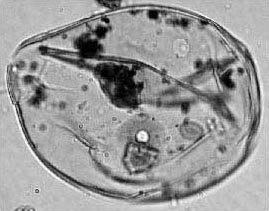
Palynology has revealed that Zea that we interpret to have been cultivated first appeared about 5100 cal B.C. The early Zea pollen grains (Figure 2a) range in size from 48.0-49.8 mcm with major axis/pore ratio of 3.8-3.9. These sizes fall within the ranges of 46.4-87.8 mcm and 3.9-9.4 established by Whitehead and Langham ( 6 ) for wild Zea (teosinte). Under Nomarski Phase, these grains show distinctive intertectile columella ( 6 ) characteristic of Zea grains. The fact that wild Zea or teosinte is not native to coastal Tabasco and especially the association of the pollen with the appearance of evidence for burning and forest clearing strongly suggests that the Zea was cultivated.

Domesticated maize pollen appears only a short time later by 5000 cal B.C. and is associated with extensive land clearing. This pollen is most likely from domesticated maize because the larger grains (Figure 2b) have sizes (>70 mcm) and major axis/pore ratios (>5.0) typical of this domesticated plant ( 6 ). These grains also have the distinctive columella characteristic of Zea.

The small Zea sp. pollen was abundant for over 2500 years, finally disappearing about 2500 cal B.C. It is unknown whether this extreme range in Zea sp. pollen grain size and morphology represents variability within a single taxon, perhaps under the selective pressure of cultivation, or cultivation of more than one variety of Zea. Early maize cobs from highland México exhibit evidence of rapid evolutionary change and a high degree of variability in cob morphology from 4300-3500 cal B.C. ( 7 ), a finding that is consistent with our pollen data.
These data on Zea relate to two controversial issues concerning maize domestication. The first issue refers to the intensity of initial cultivation. Our evidence for significant levels of burning (charcoal) and pollen of disturbance vegetation in association with the Zea pollen indicates that the initiation of cultivation was high intensity in nature, probably involving slash and burn or swidden agriculture. Thus, there was no initial period of low-level horticulture evident ( 8 ).
These data are also crucial for our knowledge of the timing of maize domestication. DNA tests of modern plants ( 9 ) have demonstrated that modern maize is most closely related to the wild grass teosinte (specifically Zea mays parviglumis) from western México (Guerrero and Michoacán). Since no research has been done in that area, we know nothing of when maize was domesticated there. Presently there are two competing hypotheses about the time frame: Early Holocene ( 10 ) or Middle Holocene ( 11 ). The Tabasco data are the first from México to verify an early domestication for maize, i.e., in the early Holocene at least 7000 years ago.
There is evidence for another cultigen, manioc (Manihot sp.), by about 4600 cal B.C. at San Andrés. The surface morphology and large size (>92 mcm) of the grain (Figure 2c) indicate that it is probably from domesticated manioc (Manihot esculentum), although the species cannot be positively identified from the pollen. Manioc is an insect pollinated plant, and its pollen is rare in sediments. Thus, abundant stands of Manihot sp. were most probably growing at San Andrés. The manioc data are in accord with new data from Panama ( 10 ) that indicate that root crops played a significant role in the diet in early Mesoamerica. DNA evidence indicates that manioc was probably domesticated in the southern Amazon Basin ( 12 ). The Panamanian data ( 10 ) demonstrate that manioc had reached the Isthmus by 7000 years ago. The Tabasco pollen find now gives us a reference point for its adoption further north in México by the early fifth millennium B.C.
This research reveals that Archaic period peoples of the Gulf Coast of México actively adopted a number of cultivated plants and incorporated them into their foraging way of life. In light of this research the Olmec civilization can now be understood as the culmination of a long period of economic development in the Gulf Coast region of México.

Sources Cited
- R.S. MacNeish, in The Prehistory of the Tehuacán Valley, Vol. 1., D.S. Byers, Ed. (Univ. of Texas Press, Austin, 1967), pp. 290-309.; The Origins of Agriculture and Settled Life (Univ. of Oklahoma Press, Norman, 1991).; and M.W. Eubanks, Latin Am. Antiquity 11, 3 (2000).
- M.D. Coe and R.A. Diehl, In the Land of the Olmec, Vol. 1, The Archaeology of San Lorenzo Tenochitlán, Univ. of Texas Press, Austin (1980).
- B.G. Thom, J. Ecol. 55, 301 (1967).
- W.F. Rust III and R.J. Sharer, Science 242, 102 (1988).; W.F. Rust III and B.W. Leyden, in Corn and Culture in the Prehistoric New World, S. Johannessen and C.A. Hastorf, Eds. (Westview Press, Boulder, 1994), pp. 181-201.
- M.D. Pohl et al., Latin Am. Antiquity 7, 355 (1996).
- D.R. Whitehead and E.J. Langham, Bull. Torrey Bot. Club 99, 7 (1965).
- B.F. Benz, Proc. Natl. Acad. Sci. 98, 2104 (2001).; D.R. Piperno and K.V. Flannery, Proc. Natl. Acad. Sci. 98, 2101 (2001).
- B. Smith, Proc. Natl. Acad. Sci. 98, 1324 (2001).
- J. Doebley, Econ. Bot. 44 (3, Suppl.), 6 (1990).
- D.R. Piperno and D.M. Pearsall, The Origins of Agriculture in the Lowland Neotropics (Academic Press, San Diego, 1998); D.R. Piperno et al., Nature 407, 894 (2000).
- G. Fritz, Current Anthro. 35, 305, (1994).
- M. Fregene et al., Theor. Appl. Genet. 89, 719 (1994); K.M. Olsen and B.A. Schaal, Proc. Natl. Acad. Sci. 96, 5586 (1999).
Submitted 03/19/2001 by:
Mary Pohl
mpohl@mailer.fsu.edu
Return to top of page |