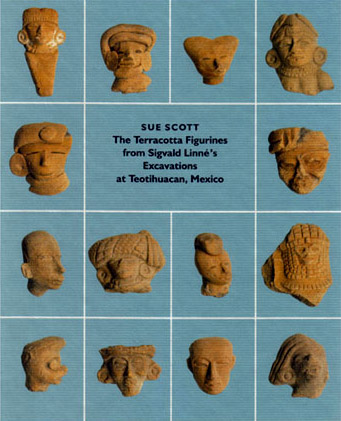
The Terracotta Figurines from Sigvald Linnés Excavations at Teotihuacán, México
Vea este informe en Español.
Printable version

Research Year: 2000
Culture: Teotihuacán
Chronology: Early Classic
Location: Central Highlands, México
Site: Teotihuacán
Abstract
Teotihuacán is justly renowned as the first and largest urban phenomenon in Central Mexican Highlands. Equally remarkable is the seemingly limitless number of small terracotta figurines which were produced at the ancient city. The Teotihuacanos did not leave portraits of their leaders or any historic personage in ceremonial art forms, nor is there evidence of a formal writing system that would name them. Unlike their contemporaries to the south, the Zapotec and Maya with whom they were in contact for centuries, they seem mute on the subject of exploits and the people who would have been involved. In fact, as archaeological exploration and decipherment go on apace, the information imbalance between Teotihuacán and its southern neighbors is greater than ever. It is ironic, and perhaps telling, that the void of recorded history at Teotihuacán is compensated by the multiplicity of human figures in the genre of terracotta figurines. It is highly likely that the Teotihuacanos did record events and picture their historic personages in material that has been destroyed through time. Nevertheless, the figurines provide the greatest amount of information about the people themselves.
Teotihuacán figurines have never received the scrutiny they deserve. In spite of the vast numbers of figurines and their association with households, they have been the most neglected and under-esteemed of all Teotihuacán artifact categories. Occasionally they are used in iconographic studies because many have elaborate clothing and headdresses with designs that seem to have symbolic meaning; but, with few exceptions, they are not the focal point.
Introduction
Figurines are mentioned inevitably in reports of early travelers and explorers, and a few are illustrated in more recent excavation reports, but to date there is a paucity of publications which demonstrate the wide range of variation. This work attempts to fill the gap partially by bringing together a large number of figurine photographs, and making comparisons in style and design with visual images in other media, and from other geographical areas.
There is a recognizable Teotihuacán figurine canon, but with seemingly endless variations. As figurines seem to be part of household ritual paraphernalia and because they occur in the thousands, they must have had a substantial cultural significance. The complete range of Teotihuacán figurine types may never be known. Each new excavation turns up some new element, and in spite of years of research throughout the literature and collections, one always finds surprises.
However broken, eroded, and humble the little figurines may seem, there is an enormous amount of information, albeit subtle, in the iconography. Much of the comparative material is found in regions far away from Teotihuacán, in culture zones that are known to have had ties with the Central Highlands, and where the iconographic themes are writ large. At Teotihuacán the corresponding images are mere suggestions, rather than statements.
Since terracotta figurines are predominantly household items, their imagery, and even morphology, can provide insights to the residents, probably at the group or family level with a few examples that point to the individual. The household unit is a topic that is receiving renewed interest; until recently most archaeological endeavors were given over to Teotihuacáns monumental architecture, public panoply, and the layout of the city. The people who actually lived at Teotihuacán were overshadowed by the city they created.
This monograph grew out of research for my doctoral thesis (Scott 1994a) and deals primarily with the terracotta figurines from Linnés excavations which were in use during the time when Teotihuacán was a flourishing city, or the Classic period. The text is divided into three sections:
Part One (Chapters 1-2)
Chapter 1 introduces the reader to the physical environment of Teotihuacán, and puts Linnés work into the context of the history of archaeological investigations. Chapter 2 includes a discussion of the tradition of figurine production and use, and the history of that specific facet of scholarly endeavor. The problem of the chronological sequence is explained. Most of the material was recovered in properly controlled excavations which receive a brief overview along with the database.
Click to view the Chronology Chart
Part Two (Chapter 3)
Chapter 3 gives a detailed description of the figurine corpus, and is designed to be used with the accompanying set of 175 numbered Plates of approximately 1,400 figurines, almost all of which were recovered in controlled excavations. This long chapter is divided into subheadings following the chronology as it is known at this time, and is further organized by figurine categories. This information can be useful in laboratory or excavation settings where identification of broken and eroded fragments is otherwise difficult. The chapter provides references to comparative material, and interpretations are made when the evidence allows.
Examples:
Plate 1 Figure b
Plate 143 Figure a
Part Three (Chapters 4-8)
The format changes from description and identification of the figurines themselves to examination of iconographic themes found in various media, placing illustrations after each section as Figures. Because the figurine material in this corpus is largely from excavations, and for that reason are broken and eroded, I have added figurines from museum collections which are more intact and provide visual information to aid in identifying the more fragmentary pieces.
Chapters 4 through 7 are interpretative studies providing insights to the material culture of Teotihuacán. These topics were selected to demonstrate the abstract nature of Teotihuacán figurines and other small artifacts, and how they reflect major iconographic themes that are more elaborate and well-developed in other media, and from other geographic areas. I discuss how it is possible to recognize authentic figurines by analyzing a group of falsifications.
Concluding remarks and suggestions for future research comprise Chapter 8. There is no single overarching theme expressed by terracotta figurines, instead there are many ideas which express, inter alia, the combination of human/animal traits, a consistency of patterning in accoutrement suggesting affiliation with social groups, and even morphological characteristics which might refer to individual people. A large corpus of figurines is crucial for making these interpretations. Research, writing and compiling this manuscript has been a most gratifying experience, and I hope the results will bring readers a deeper understanding of the social environment of the residents of ancient Teotihuacán.
Acknowledgements
The National Museum of Ethnography expresses its sincere appreciation and gratitude to the Foundation for the Advancement of Mesoamerican Studies, Inc. (FAMSI), the Swedish Council for Research in the Humanities and Social Sciences (HSFR), and Magn. Bergvalls Stiftelse for their economic support, which made it possible to have Dr. Sue Scotts important research on the Teotihuacán terracotta figurines published in the Monograph Series of the museum. Dr Sue Scotts book includes 175 plates, each having several examples. This report includes a representative sampling of the figurines.
Click to view Images of the Figurines
To order The Terracotta Figurines from Sigvald Linnés Excavations at Teotihuacán, México, go to University of Pittsburgh Latin American Archaeology Publications at:
http://www.pitt.edu/~laap/publist/otherpub.html.
Available in Europe from:
The National Museum of Ethnography
attention: AC Lagercrantz
Box 27140, S-102 52
Stockholm, Sweden
E-mail: ethnos@etnografiska.se
Report submitted 09/11/2001
Return to top of page |