|
FAMSI © 2005: Kristin Sullivan |
|
Making and Manipulating Ritual in the City of the Gods: Figurine Production and Use at Teotihuacán, México
Research Year: 2004 Table of Contents
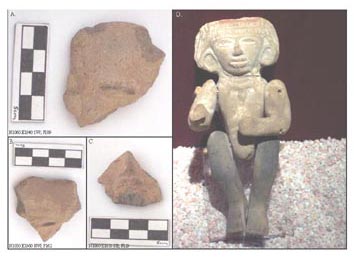
Abstract Teotihuacán was the largest city of its time in ancient Mesoamerica, with significant evidence for specialized production and the distribution of craft goods throughout the city and abroad. Evidence for the production of a variety of goods has been recovered from several apartment compounds throughout the city. For example, specialized pottery production has been identified at the excavated apartment compound Tlajinga 33 or 33:S3W1 (Hopkins 1995; Sheehy 1992; Storey 1992; Sullivan 2002, 2005; Widmer and Storey 1993), while excavated materials from Tlamimilolpa, 1:N4E4, indicate production of textiles, basketry, and other items involving fiber work (Linné 2003b [1942]; Manzanilla 1996). Excavations at Tetitla (1:N2W2) recovered bone tools for working hides and polishing pottery (Manzanilla 1996; Pasztory 1997) and surface collections suggest obsidian tool production at the apartment compound at 29:N5W3 (Spence 1981, 1984, 1986, 1987). This project focuses on evidence for the production of ceramic figurines at an apartment compound located outside of the much-studied ceremonial center of Teotihuacán, ca. one kilometer west of the Pyramid of the Moon. Teotihuacán fue la ciudad más grande en sus tiempos en la antigua Mesoamérica con evidencia significativa de producción especializada y distribución de mercancías artesanales, a través de la ciudad y fuera de ella. Se ha recuperado evidencia de la producción de una variedad de mercancías de varios conjuntos de apartamentos a través de la ciudad. Por ejemplo, se identificó producción de alfarería especializada en el conjunto de apartamentos llamado Tlajinga 33 o 33:S3W1 (Hopkins 1995; Sheehy 1992; Storey 1992; Sullivan 2002, 2005; Widmer y Storey 1993); mientras que materiales excavados de Tlamimilolpa, 1:N4E4, indican la producción de textiles, canastas, y otros artículos que involucran el trabajo de la fibra (Linné 2003b [1942]; Manzanilla 1996). Excavaciones en Tetitla (1:N2W2) recuperaron herramientas de hueso para trabajar pieles y pulir alfarería (Manzanilla 1996; Pasztory 1997) y colecciones de superficie sugieren producción de herramientas de obsidiana en el conjunto de apartamentos en 29:N5W3 (Spence 1981, 1984, 1986, 1987). Este proyecto se concentra sobre la evidencia para la producción de figurillas de cerámica en un conjunto de apartamentos ubicado en las afueras del tan estudiado centro ceremonial de Teotihuacán aproximadamente un kilómetro al occidente de la Pirámide de la Luna. Click to download the report in PDF format: The PDF files require Adobe Acrobat Reader.
Submitted 06/15/2005 by: |
||
| Return to top of page | ||
|
Text links to all pages at this site are available at the FAMSI INDEX |
||