|
FAMSI © 2004: Ronald A. Castanzo |
|
Tepeaca Kiln Project Excavations A total of six units were excavated involving three kilns and three areas associated with kilns on the Cerro Tlaquexpa hillside. Five units were placed within the limits of PAT site 623 and one was placed in PAT 621; PAT site numbers were used to designate these excavations. All were within 700 m of the road between San Felipe Tenextepec and San Lorenzo. From a number of contexts, ceramic and limestone samples were taken for INAA analysis at the Smithsonian Institution.
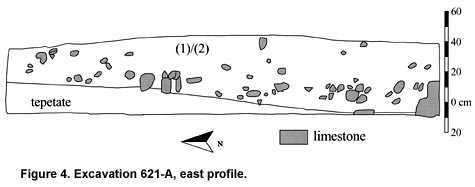
Operation 621-A This excavation consisted of a 3 × 1 m unit situated approximately equidistant (20 m) from kilns K37 and K39 in an area with dense mounded limestone rubble at the surface (Figure 4, shown above). The excavation proceeded to tepetate, encountered throughout the pit first in the northern area (at approximately +10 cm, relative to the datum) and eventually in the southern area (at approximately -10 cm). The natural/cultural stratigraphy is divided into two contexts:
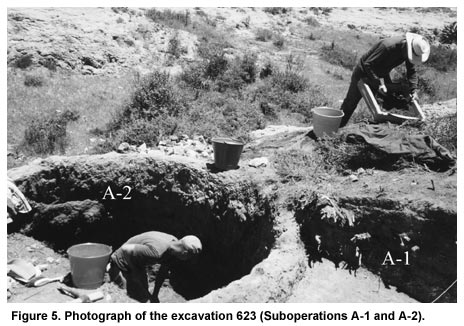
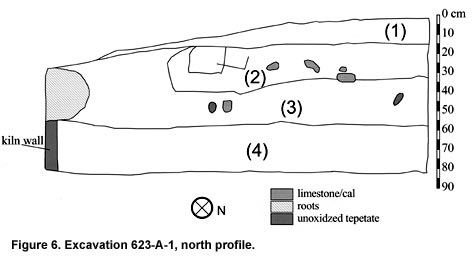
Operation 623-A Suboperation A-1 consisted of a 2 × 2 m unit directly above and approximately to the east of kiln K1, at the edge of a large earth island on the exposed tepetate (Figure 5, shown above). The surface of the island within the unit ranged from 2 cm below the datum (situated near the northeast corner) at the northeast corner to approximately 50 cm below the datum in the southwest corner. The unit was eventually excavated to 80 cm throughout (Figure 6, shown above). The cultural/natural stratigraphy in the unit is divided into four contexts:
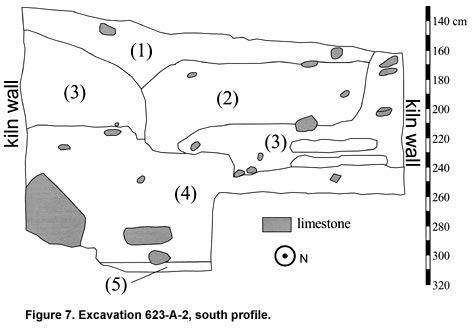
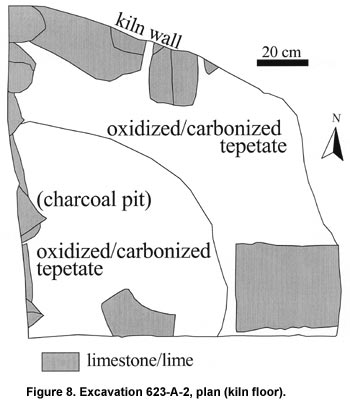
Suboperation A-2 consisted of the northern one-half of kiln K1 lying just off the western edge of the large earth island (below Suboperation A-1). A few meters further west lies a small channel formed by local seasonal run-off. The ground surface within the portion of the kiln wall visible above ground is 131-161 cm (sloping away from the island) below the datum. Ultimately, the excavation proceeded to the base of the kiln, 311 cm below the datum (Figure 7, shown above). Beginning at a depth of about 260 cm, excavation was conducted only in the eastern half of the unit (a one-quarter section of kiln). The walls of the kiln are comprised of highly oxidized tepetate (reddish-orange in color) approximately 20 cm thick. The floor of the kiln is composed of oxidized or blackened tepetate with frequent white (lime) inclusions. The fill within K1 is a combination of alluvium resulting from the actions of the ephemeral stream that runs today just to the west and soil eroding from the island itself. Chunks of limestone were common throughout. The natural stratigraphy is divided into five contexts:
Charcoal from lot w was radiocarbon-dated to A.D. 1913±50 (uncalibrated). Thus, the kiln is not at all associated with the prehispanic (Classic Period predominating) site excavated above in 623-A-1, although this site was undoubtedly the source of much of the fill within the kiln. At least some of the larger chunks of limestone (one was 50 cm on its long axis) probably lined the edges of the original kiln opening and subsequently tumbled into the kiln after it went out of use. Thus, the kiln was essentially a cylindrical pit almost 3 m in depth. It was into the prehispanic site that the historic lime kiln (K1) was constructed early in the 20th century probably in association with construction or renovation at a nearby hacienda, the ruins of which lie approximately 400 m to the southeast (bricks were found as part of context [4] identical to those of the hacienda).
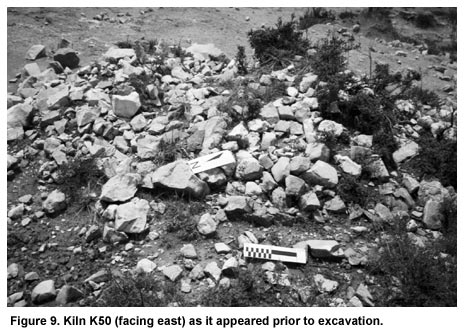
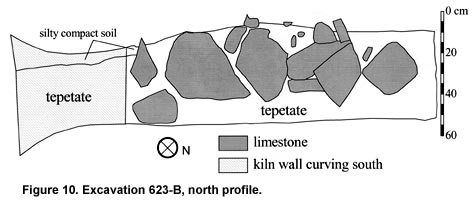
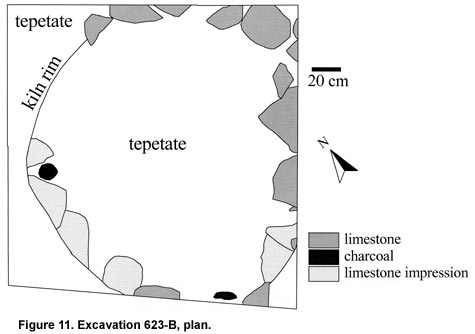
Operation 623-B This operation was the excavation of an oval pit kiln (approximately 2 × 2.5 m), designated K50 (Figure 9, shown above), in a 2 × 2 m unit. A small section of the kiln edge was visible at the surface. On the surface of the mounded limestone rubble, sherds dating to the Postclassic Period were found. A pile of limestone rubble filled the kiln to a height of 31 cm above the level of the tepetate. The level of the tepetate ranged from +5 cm in the northeastern corner of the unit to -28 cm in the southeastern corner (measurements relative to the datum). The dish-shaped pit was dug directly into the tepetate substrate down to a depth of approximately 40 cm (55 cm below the datum) at the center; the walls of the pit were lined with large pieces of limestone (Figures 10 and 11, shown below).
The fill within the pit was mostly limestone chunks (some over 40 cm on their longest axis) together with silty to clayey-silty soil. The fill can be divided into two contexts:
K50 is interpreted as having functioned as a lime-processing kiln. Charcoal recovered in lot f was radiocarbon-dated to 1000 B.C. (1200-850 B.C. at 95% probability), lying on the cusp of local Early and Middle Formative periods. The Terminal Formative-Classic sherd found in lot b, the virtual entirety of which lay above (and outside of) the pit itself, is therefore an intrusive element along with probably most or all of the soil recovered with the limestone rubble (believed to have been deposited as a single event).
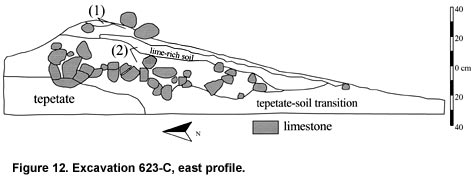
Operation 623-C This 1 × 3 m unit was excavated a few meters to the southwest of the 623-B unit (K50) in limestone rubble similar in character to that of 623-B, although no kiln rim was visible at the surface (Figure 12, shown above). Limestone chunks in addition to some charcoal and lime pieces were found throughout. This area may have been associated with the operation of nearby K50. The stratigraphy is divided into two contexts:
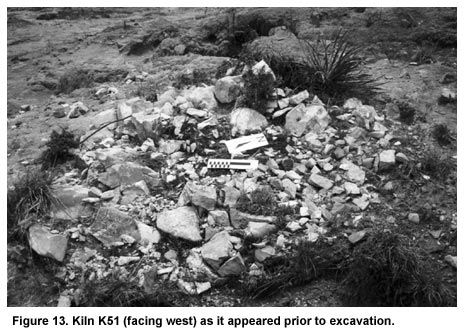
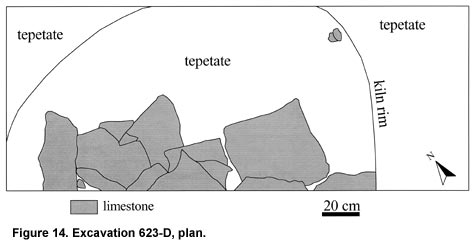
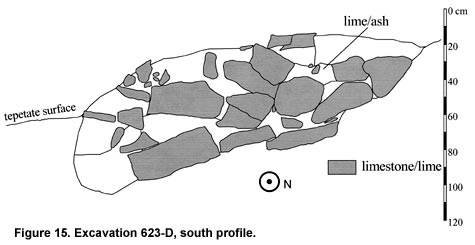
Operation 623-D This excavation consisted of a 1 × 2.5 m unit that bisected K51, an approximately circular (2 × 2 m) lime pit kiln excavated directly into the sloping tepetate of Cerro Tlaquexpa (Figures 13 and 14, shown above). Most of the kiln rim was visible at surface. No material was recovered on the surface of this site, but it is very similar in character to K50 (and many of the other apparent lime kilns) in that it consists mainly of mounded limestone rubble (approximately 25 cm above the level of tepetate and 15 cm below the datum at its highest point). The fill within the pit was comprised mostly of limestone chunks (and masses of lime) together with sandy-silty soil (Figure 15, shown below).
Several carbon samples were recovered, but none has been analyzed to date. The excavation continued to the tepetate floor of the kiln 105 cm below the datum at its deepest at its eastern edge (the furthest down slope). In its center, the floor of the kiln lies approximately 55 cm below the level of the tepetate (100 cm below the datum). Although some changes in soil color and texture were evident, the limestone rubble fill in the pit is believed to have been deposited in one event designated context [1]:
|
||
|
Text links to all pages at this site are available at the FAMSI INDEX |
||